AI systems don’t usually fail because of weak models.
They fail because the data they learn from becomes stale, incomplete, or disconnected from reality.
For products trying to understand work, skills, and hiring demand, labor market data for AI has become essential. Job postings reflect how roles change, which skills rise in demand, and where opportunity is shifting, often before these trends appear anywhere else. Without access to this signal, AI outputs slowly drift away from what’s actually happening in the market.
Why Job Data Is Now a Requirement for Modern AI Products
Today’s AI products rely on external data to remain relevant. This is especially true for systems operating in hiring, workforce planning, and economic intelligence. Teams building LLM-powered tools increasingly depend on a job data API to continuously ground their models in current market conditions.
Rather than treating jobs as static content, AI systems now consume job data as a living input, something that evolves daily and informs decisions in real time.
The Operational Reality of Collecting Job Data Yourself
Many AI teams initially attempt to build their own job collection systems. On paper, a job scraping API sounds manageable. In practice, it quickly becomes fragile.
Career sites change layouts. Anti-bot protections break crawlers. JavaScript-heavy pages require constant tuning. Over time, engineering teams spend more effort maintaining infrastructure than improving their models. What starts as a tactical solution slowly becomes a long-term operational burden.
Why Crawling the Web Is Not the Same as Building Intelligence
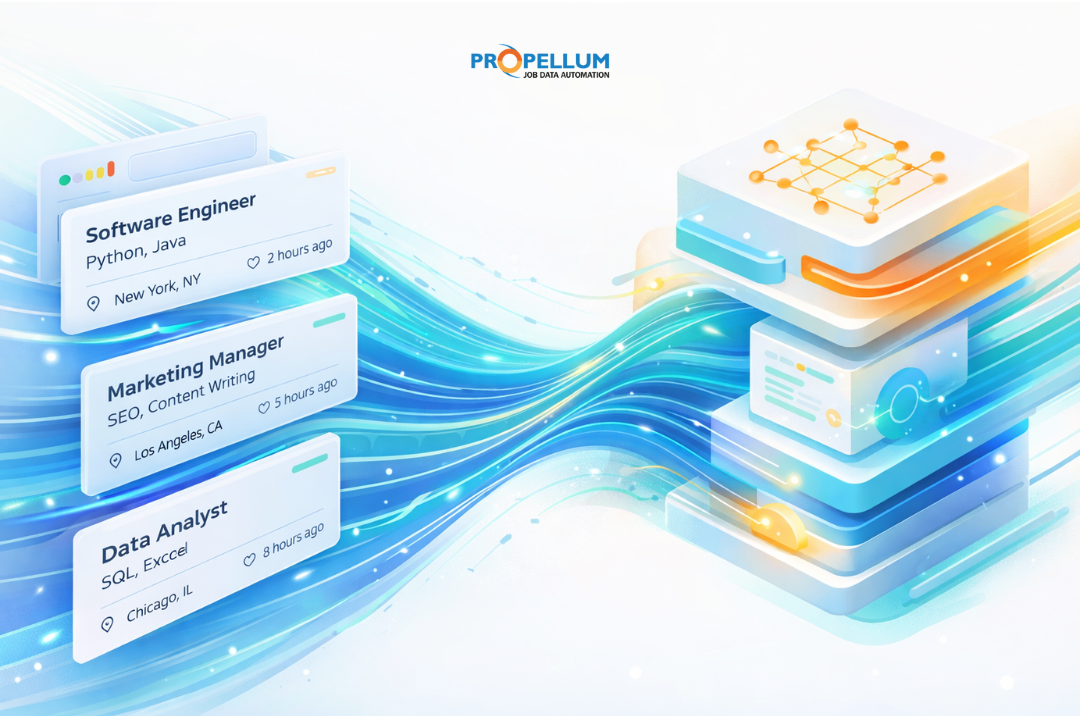
Crawling job pages is only the first step. Turning that raw data into something usable for AI is far harder. Effective job crawling for AI companies requires handling change detection, deduplication, normalization, and structured extraction at scale.
Propellum was built around this reality, treating job collection as an infrastructure problem rather than a one-time scrape. The complexity stays behind the scenes, while AI teams receive consistent, usable data.
Why Real-Time Job Signals Matter More Than Ever
AI systems operating in fast-moving domains can’t rely on delayed updates. A real-time job listings API allows models to reflect what’s happening now, not weeks or months later.
This freshness is critical for recommendation engines, copilots, and analytics platforms that surface insights users expect to trust. When job data updates lag behind the market, AI decisions lose credibility quickly.
Why History Is Just as Important as Freshness
Training AI models requires context. Historical job datasets provide the long-term view needed to understand trends, skill evolution, and market cycles.
Without history, models lack depth. Without real-time signals, they lack relevance. Strong AI systems depend on both, using historical data to learn patterns and real-time data to stay grounded in the present.
Who Uses Job Data Beyond Job Boards
Job data is no longer consumed only by recruiting websites. Today, a job data feed for AI/ML supports a wide range of use cases: talent intelligence platforms, consulting research, workforce planning tools, economic analysis, and skills mapping systems.
Across industries, job data has quietly become a shared foundation, powering products that need to understand how work is changing at scale.
Why APIs Are Replacing Static Feeds
Static feeds and bulk files struggle to support modern architectures. APIs fit naturally into AI pipelines, enabling teams to pull updates, subscribe to changes, and integrate data directly into models. This shift has made job scraping less about collecting pages and more about delivering reliable signals.
This is where Propellum positions itself, not as a job board, but as infrastructure that allows teams to consume job intelligence programmatically and at scale.
Job Data as a Foundation for Talent Intelligence
When structured and maintained correctly, job data becomes more than listings; it becomes insight. A talent intelligence data API enables AI systems to connect roles, skills, locations, and demand patterns into something decision-ready.
For AI companies, this means less time worrying about data quality and more time building systems that reason, predict, and assist effectively.
Building AI Without Carrying the Weight of the Internet
The future of AI isn’t about collecting more data, it’s about consuming the right data reliably. Propellum exists to remove the operational burden of job data collection, normalization, and maintenance, so AI teams can focus on building models and products that matter.
As AI systems continue to expand into hiring, workforce intelligence, and economic analysis, job data will remain a core dependency. Treating it as infrastructure, not content, is what allows AI products to scale with confidence.