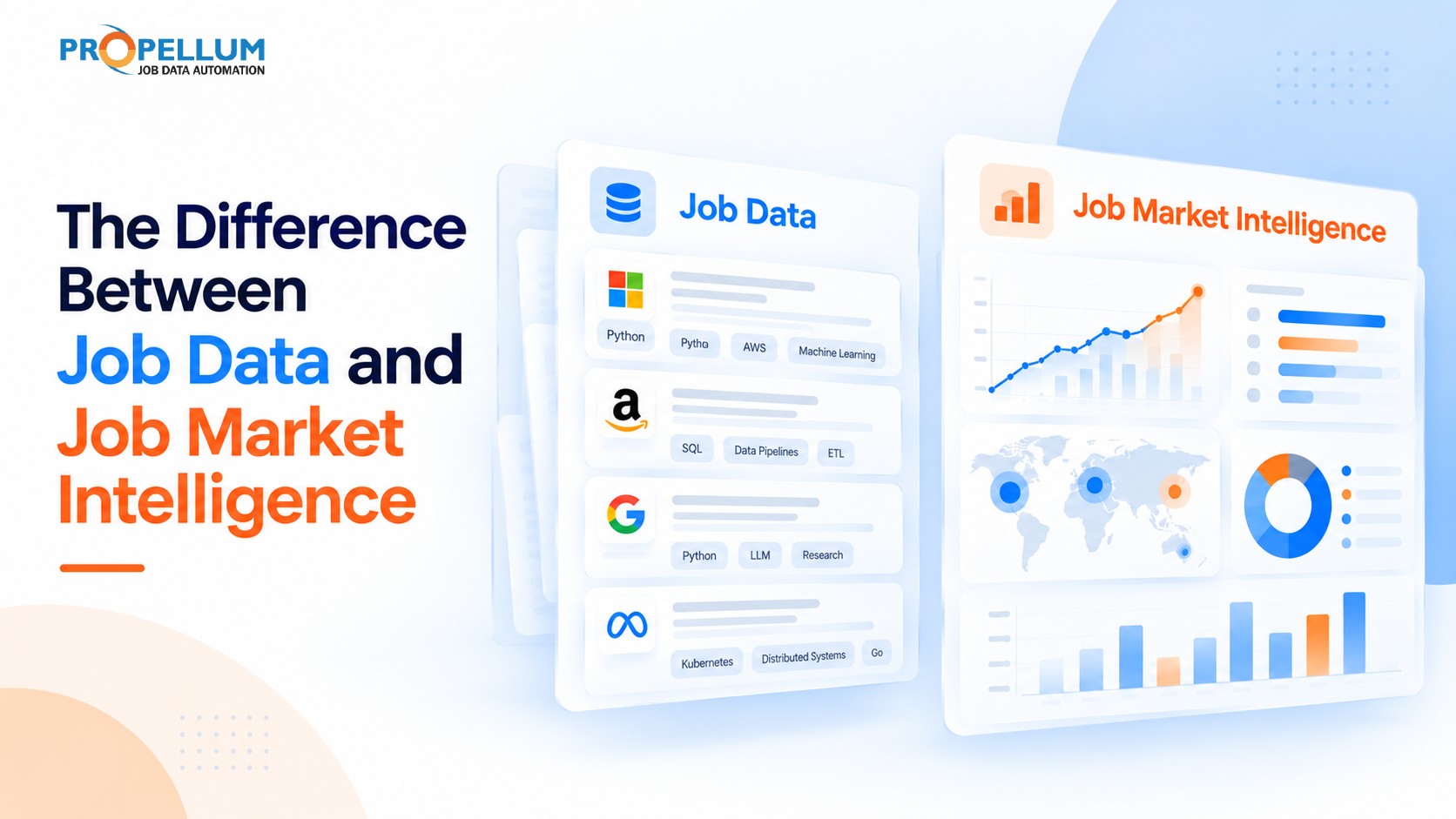
A database can tell you how many jobs were posted yesterday. Job market intelligence can tell you what those postings mean for the market you are watching. That distinction matters.
Companies generate enormous amounts of job data every day. Job titles, descriptions, locations, skills, salaries, seniority, posting dates and employer information all become useful once they are structured. But collecting those fields is only the beginning.
The real value comes from connecting them across companies, roles, skills, locations and time to understand what is changing. That is the difference between job data and job market intelligence.
What is job data?
Job data is the underlying information contained in job postings. A single job record might include:
- Company
- Job title
- Job description
- Location
- Skills
- Seniority
- Salary
- Employment type
- Posting date
- Remote or onsite status
For example:
Senior Machine Learning Engineer
Company: Company A
Location: New York
Skills: Python, PyTorch, AWS
Seniority: Senior
Posted: September 28
That is useful data. But on its own, it tells you relatively little about the broader market. You know that one company is hiring one person for one role. You do not yet know whether this represents a broader change.
What is job market intelligence?
Job market intelligence starts when individual job records are connected and analyzed as a market. Take the same example.
Now imagine that over the last 30 days:
- 42 companies posted ML engineering roles
- ML job postings increased 24%
- Demand increased across New York, Austin and London
- MLOps appeared in significantly more postings
- Several companies began hiring senior AI leadership
- The increase is concentrated among technology companies
The individual job postings have now become something more useful.
They show a pattern. That pattern can help answer questions such as:
Which companies are expanding?
Which roles are becoming more important?
Which skills are emerging?
Which locations are seeing more hiring?
Which industries are changing their hiring mix?
This is job market intelligence. Job data tells you what was posted. Job market intelligence helps you understand what is changing.
The difference in practice
Consider these two views.
Job data (Company A)
- 8 Data Engineer jobs
- 5 ML Engineer jobs
- 3 Analytics jobs
- 1 Head of Data
Useful information.
Job market intelligence (Across 30 days):
7 companies
48 data and AI roles
+32% hiring activity
ML and infrastructure skills increasing
New hiring activity across two additional markets
Now you can investigate a broader question: Is the market increasing investment in data and AI capabilities? That is a much more useful question for a recruiter, sales team, researcher or workforce analyst.
Why the distinction matter? The difference becomes especially important when you are trying to make decisions from job data.
1. Recruiters can move beyond individual vacancies
A recruiter does not only need to know that a company has posted a Data Engineer role. They may want to know:
- Which companies are hiring similar profiles?
- Where is hiring accelerating?
- Which skills are becoming more common?
- Which markets have the strongest activity?
- Which companies may need recruiting support?
That requires job market intelligence rather than a list of vacancies. For example, if 30 companies suddenly increase hiring for cybersecurity roles in one region, that pattern may be more useful to a staffing firm than any individual opening. It can help the team decide where to build a talent pool, which companies to approach and which market to investigate.
2. Sales teams can identify accounts worth watching
Job postings can also become an account intelligence signal. Suppose a company begins hiring:
- 5 Data Engineers
- 3 ML Engineers
- 2 Analytics Managers
- 1 Head of Data
Individually, these are vacancies. Together, they suggest that the company is actively expanding its data function. A sales team can use that signal to investigate whether the company has a relevant technology, infrastructure or services requirement.
The important distinction is that the data does not tell sales “this company will buy.” It tells them: Something is changing inside this account. That can be enough to justify a closer look.
3. Investors can study changes in company behavior
Job postings can also form part of an alternative-data strategy. An investor may want to study:
- Hiring velocity
- Changes in workforce composition
- Geographic expansion
- Technology adoption
- Emerging capabilities
- Leadership hiring
- Sector-level hiring patterns
For example, a company that moves from occasional AI hiring to sustained hiring across machine learning, infrastructure and AI leadership is displaying a different hiring pattern. That does not automatically tell you what will happen to the company’s financial performance. It does, however, provide another observable data point that researchers can compare with other information. This is where historical job data becomes particularly valuable.
4. Workforce teams can see how the market is changing
For internal recruiting and workforce planning, the question is often broader:
What skills and roles will matter next?
Looking at individual jobs makes that difficult. Aggregating postings across employers can reveal:
- Skills appearing more frequently
- Roles gaining or losing momentum
- Changes in geographic hiring
- Shifts in seniority
- New technology requirements
- Changing employer priorities
A workforce team can then compare its own hiring plans against what employers across the market are doing.
From job data to intelligence: the four layers
A useful way to think about the progression is:
1. Collect – Gather job postings from relevant sources.
2. Structure – Normalize companies, job titles, locations, skills, seniority, and other attributes.
3. Connect – Aggregate the data across companies, markets, and time.
4. Interpret – Identify patterns, changes, and signals that are relevant to a particular business question.
The first three create the foundation. The fourth creates the intelligence. This is also why the underlying data infrastructure matters. If company names are inconsistent, job titles cannot be compared, duplicate postings inflate counts, or historical records disappear, the conclusions drawn from the dataset can quickly become unreliable.
What should you look for in job market intelligence?
If you are evaluating a job data provider, do not stop at asking: How many jobs do you have?
Ask what you can actually understand and measure with those jobs.
- Source coverage – Can the data capture hiring activity directly from employer career pages and other relevant sources?
- Consistency – Are companies, roles, locations and skills structured consistently enough to compare them?
- Historical depth – Can you examine how hiring activity changes over months or years?
- Freshness – How quickly does new hiring activity become available?
- Granularity – Can you analyze hiring by company, role, skill, location, seniority and other relevant dimensions?
- Traceability – Can you understand where a job record originated and how it changed?
- Customization – Can you build datasets around the companies, markets, roles or geographies that matter to your use case?
These questions determine whether you are buying a collection of job postings or building a foundation for job market intelligence.
The role of structured job data
This is where structured data becomes particularly important. Imagine trying to compare:
Senior Machine Learning Engineer with:
ML Engineer
and:
Machine Learning Specialist
If every posting remains a block of unstructured text, market-level analysis becomes difficult. Normalization can bring those records into a comparable structure.
The same applies to:
- Companies
- Locations
- Skills
- Seniority
- Industries
- Employment types
At Propellum, this structured layer sits between the original employer job posting and the intelligence product built on top of it. The goal is not simply to deliver more job records.
It is to make those records usable across different analytical and operational workflows.
Job data is the raw material. Intelligence is the outcome.
This distinction is easy to miss because both products can start with the same underlying job postings. The difference is what happens next.
| Job Data | Job Market Intelligence |
| Individual job records | Market-level patterns |
| Job titles | Role trends |
| Employer postings | Company hiring activity |
| Skills in a posting | Emerging skills |
| Job locations | Geographic hiring trends |
| Posting dates | Hiring velocity |
| Current vacancies | Changes over time |
| Data collection | Analysis and interpretation |
Neither replaces the other. Job data is the foundation. Job market intelligence is what you can build from it.
The practical takeaway
If you are building a recruiting platform, sales intelligence product, workforce analytics solution, or investment research model, start by defining the question you want the data to answer.
Then work backwards.
What decision are you trying to make?
↓
What market signal would help inform it?
↓
What job data do you need to construct that signal?
↓
What structure, history, and coverage do you need?
That approach prevents a common mistake: buying a large job dataset and only later figuring out what you can actually do with it. The most valuable job data is not necessarily the dataset with the largest number of records. It is the dataset that lets you see a meaningful change, measure it consistently, and connect it to a real business question.
Job data consists of individual job records and their attributes. Job market intelligence connects those records across employers, roles, skills, locations and time to identify patterns and changes in the hiring market.
Job data becomes market intelligence when it is structured, normalized, aggregated and analyzed across relevant dimensions. This allows users to identify trends such as hiring velocity, emerging skills, geographic expansion and changes in employer activity.
Historical data lets you compare hiring activity over time. Without a historical baseline, it is difficult to determine whether a change represents a meaningful trend or simply a temporary increase in postings.
Recruiters, staffing firms, sales intelligence teams, workforce planners, HR technology companies, researchers and investment teams can use job market intelligence for different purposes.
No. Volume alone does not create intelligence. Source coverage, data quality, normalization, historical depth, freshness, and the ability to connect records across companies, roles, skills and time are equally important.