Every job board needs a source for its listings. Career page crawling and job board scraping are the two approaches most operators choose between, and both are legitimate ways to get job data onto a platform. They work differently, produce different results, and carry different tradeoffs. Understanding where those tradeoffs actually show up is what determines which one is the right fit for a given board.
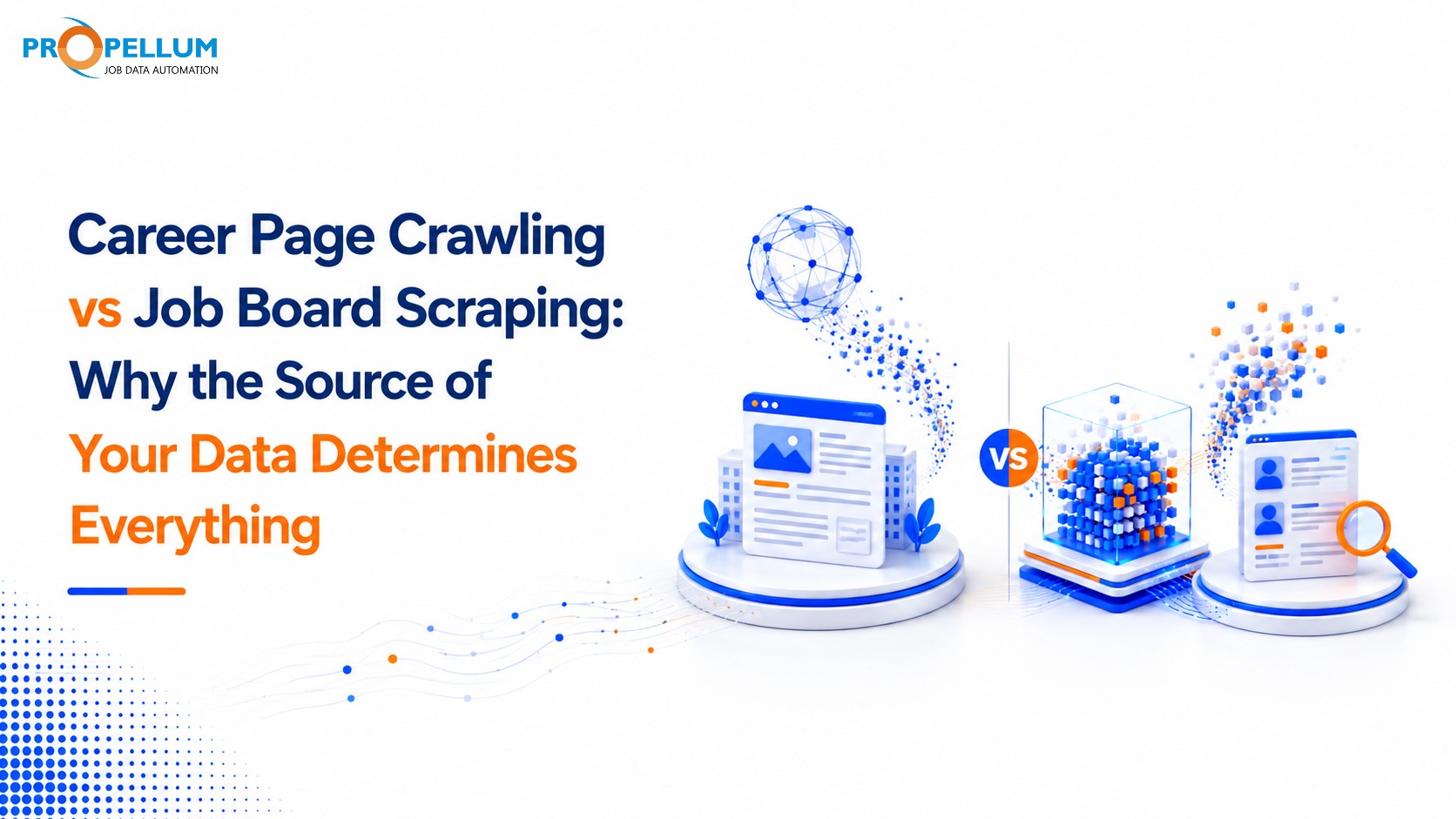
Career page crawling collects listings directly from employer career pages at the original source. Job board scraping collects listings from other job boards, which have already collected them from somewhere else. The distance from the original source changes the freshness, accuracy, and legal risk profile of the data in ways that compound as the board grows.
What Job Board Scraping Produces
A job board scraper visits another platform, extracts the visible listings, and delivers them to your board. Volume arrives quickly. The tradeoff is that the data has already passed through at least one intermediate layer before it reaches you.
Every quality limitation that exists upstream comes with it. Freshness lag from the source board’s collection cycle. Duplicates from listings that appeared across multiple sources. Listings that closed yesterday but have not been removed yet. None of these are under your control because the data was not collected by you.
There is also a legal dimension. Most major job board platforms prohibit automated collection of their listings in their terms of service. Enforcement has been inconsistent, but building a data pipeline on scraped board content means building on a legal foundation that can be challenged.
What Career Page Crawling Produces
Career page crawling goes to the employer directly. The crawler visits the employer’s own careers page and collects the listing at the original source. There is no intermediate board in between.
This changes four things. Freshness: a listing posted on Tuesday morning appears on your board within hours rather than days. Originality: the data is employer-authored and unmodified, not reformatted through an aggregator. Legal standing: collecting from a publicly available employer career page sits in a different legal position from re-scraping another platform’s proprietary index. And deduplication: when data arrives from a single authoritative source, deduplication is manageable. When it has passed through multiple boards, each of which may have been collected from multiple sources, the same listing arrives under dozens of variants.
Why the Source Matters More at Scale
The difference between the two approaches is visible at any scale and structural at large scale. At a few thousand listings, freshness lag and duplicate rates from scraper-sourced data are manageable. At hundreds of thousands of listings drawn from many scraped sources, the compounding quality problems become the primary constraint on how good the board can get.
The boards that have scaled to millions of listings without significant data quality problems are almost universally built on career-page-first infrastructure. The boards that hit a quality ceiling are usually the ones that prioritised volume over source control in the early stages. The difference also shows in search quality: a board whose listings are deduplicated at source and fresh within hours produces a search experience candidates return to.
Propellum collects exclusively from employer career pages across 15+ countries, with no re-aggregation from other boards. Over a billion job records processed across 25 years, with freshness, deduplication, and enrichment built into the pipeline before delivery.
Get a free test feed in 24 hours →
Frequently Asked Questions
Career page crawling collects listings directly from employer career pages at the original source. Job board scraping collects listings from other boards that have already aggregated them from various sources. Career page data is fresher, legally cleaner, and easier to deduplicate because it comes from the authoritative source rather than a copy of a copy.
Most major job board platforms prohibit scraping in their terms of service. Enforcement varies, but the legal exposure is real. Collecting from publicly available employer career pages sits in a different position: the employer published the listing for public discovery, and a crawler reading it directly from the source has a more defensible basis.
Job board scraping inherits the collection timing of whatever board is being scraped. If that board collects in daily batches, your data arrives a day old at minimum. If it collects from another board that also batches, the lag compounds. Career page crawling goes to the source at the cadence you set, so freshness is controlled by your pipeline rather than inherited from someone else’s.
Search quality depends on titles being normalised, locations being queryable, skills being structured, and listings being live. All of these are easier to maintain when data comes from a single authoritative source rather than from multiple aggregated layers with inconsistent formatting and inherited quality gaps.
The quality difference is visible from the start and becomes structural at scale. At hundreds of thousands of listings drawn from multiple scraped sources, compounding duplicate rates, growing freshness lag, and increasing legal exposure become the primary constraints on data quality. Boards built on career-page-first infrastructure avoid these constraints by design.
- Why Job Data Quality Matters More Than Job Data Volume
- What Makes Propellum’s Job Data Reliable Enough for AI and Business Intelligence?
- How B2B Sales Teams Use Job Posting Data to Find Companies Ready to Buy
- What Job Data Can Tell Investors & Finance Professionals Beyond Traditional Financial Data
- Inside the Job Data Pipeline: From Employer Career Pages to Job Boards