Visit three major job boards for the same search, and you will see the same listings, often with the same titles, descriptions, and formatting errors, arriving with the same delay from the original posting. That overlap is expected. These boards pull from the same upstream sources.
What they also share, invisibly, is the same gap.
A meaningful share of job openings from major employers never gets syndicated to LinkedIn, Indeed, or any aggregator. They are posted to the employer’s career page and nowhere else. A job board that builds its inventory by aggregating from other job boards will never carry these listings. The only way to access them is to go to the employer’s career page directly.
Why Some Jobs Are Never Posted Anywhere Else
The assumption most job board operators make is that every job that exists eventually finds its way onto a major platform. For many employers, that assumption is wrong.
Large companies with established talent brands often post roles with the expectation that qualified candidates will find them without paid distribution. A Google, a McKinsey, or a Tata Consultancy Services does not need to pay to syndicate every opening. They post to their career page and trust that the candidates they want are already watching. The role stays exclusively on the career page for days or weeks before anything is distributed elsewhere, and in many cases it is filled before it ever is.
Some roles are never syndicated at all. Internal referral pipelines fill them before the listing needs external reach. Others are posted in specific geographies or business units where paid distribution is not part of the process. And a growing number of employers have deliberately moved away from broad syndication to manage application volume, keeping their listings on the career page to reach candidates who found the company through research rather than a feed.
What Job Boards That Aggregate From Other Boards Are Missing
When a job board sources its inventory by pulling from LinkedIn, Indeed, or other aggregators, it inherits exactly the listings those platforms chose to carry. It does not inherit the listings those platforms never had.
The HiringCafe founder built that platform specifically to surface jobs that were not posted on LinkedIn. UnlistedJobs built its competitive positioning entirely around career-page-exclusive roles. Both are responding to the same insight: the most interesting segment of the job market, the roles at companies that either do not syndicate or syndicate selectively, is systematically absent from any board that sources from other boards.
For a job board operator, this represents a real gap in coverage that volume cannot close. Adding more sources does not help if those sources are all pulling from the same aggregated pool. The only way to carry the listings that nobody else has is to collect them from where they actually exist: the employer’s career page.
What Career Page Crawling Changes
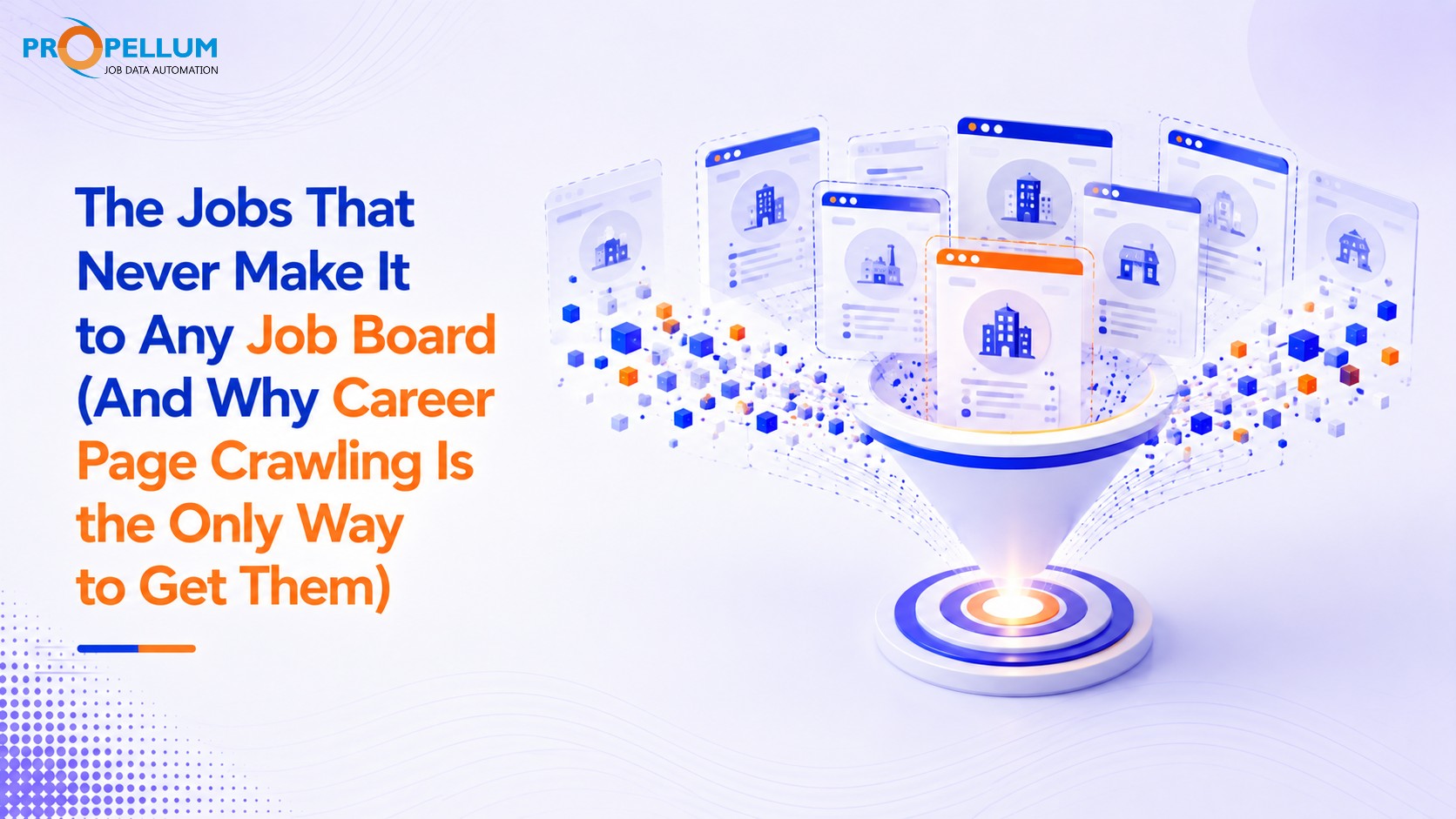
A career page crawler visits employer career pages directly, collects listings at the point of original posting, and makes them available on your board before they appear anywhere else, if they ever do. For roles that are never syndicated, this is the difference between having them and not having them.
The commercial argument for a job board is straightforward. A board that carries listings nobody else has is a board candidates come back to. A board that carries the same listings as every other aggregator is a board candidates use once and abandon when they realise its inventory mirrors what they already searched for. Unique coverage is the differentiation that makes a board worth returning to, and career-page-only roles are the only category of listing that is genuinely exclusive by definition.
At scale, the effect compounds. A board operating a career page crawler across thousands of employers is continuously surfacing roles that no aggregator-dependent board can carry. Every day its crawler runs, it widens the gap between its inventory and the inventory available anywhere else.
Propellum‘s crawler operates across employer career pages in 15+ countries, built on 25 years of career-page-first collection across more than a billion job records. The listings it delivers include roles that exist nowhere else in the market.
Get a free test feed and see what career-page-exclusive listings look like for your board →
Frequently Asked Questions
Several reasons. Large employers with strong talent brands post to their career pages and expect qualified candidates to find them without paid syndication. Some roles are filled through internal referral pipelines before external distribution is needed. Others are posted to specific geographies or business units outside standard syndication workflows. And some employers deliberately limit syndication to manage application volume, keeping roles on their career page to attract candidates who found the company through research.
Unlisted jobs are roles posted exclusively on an employer’s career page and not distributed to any job board or aggregator. They represent a segment of the market that is systematically absent from boards that source their inventory by aggregating from other platforms. For job seekers who search exclusively on aggregators, these roles are invisible. For job boards with career page crawlers, they are a source of unique inventory that competitors cannot access.
A job board that carries listings no other board has is a board candidates return to. Aggregator-dependent boards carry overlapping inventory because they pull from the same upstream sources. A career page crawler collects directly from employers, including employers who never syndicate, giving the board access to roles that are definitionally exclusive. This unique coverage is the practical basis for differentiation in a market where most boards serve the same listings.
A production-grade career page crawler operating on a continuous cycle surfaces listings within hours of the original posting. Aggregator-dependent boards add at least one additional collection cycle on top of that, which means career-page-crawled listings appear on your board before a competing board that sources from aggregators would even have them in its system.
Large employers with established talent brands, companies in competitive hiring markets who want to manage application volume, businesses with strong internal referral cultures, and organisations in markets where paid job board distribution is not standard practice. These tend to be the employers whose roles are most sought after by candidates, which is precisely why carrying their listings exclusively is commercially valuable.
- The Jobs That Never Make It to Any Job Board (And Why Career Page Crawling Is the Only Way to Get Them)
- Why Structured Job Data Is Now Non-Negotiable for Job Boards Competing in AI Search
- Your Job Feed Is Only as Good as Where the Data Comes From
- How Job Board Data Quality Directly Affects How Much Revenue a Job Board Can Generate
- Career Page Crawling vs Job Board Scraping: Why the Source of Your Data Determines Everything