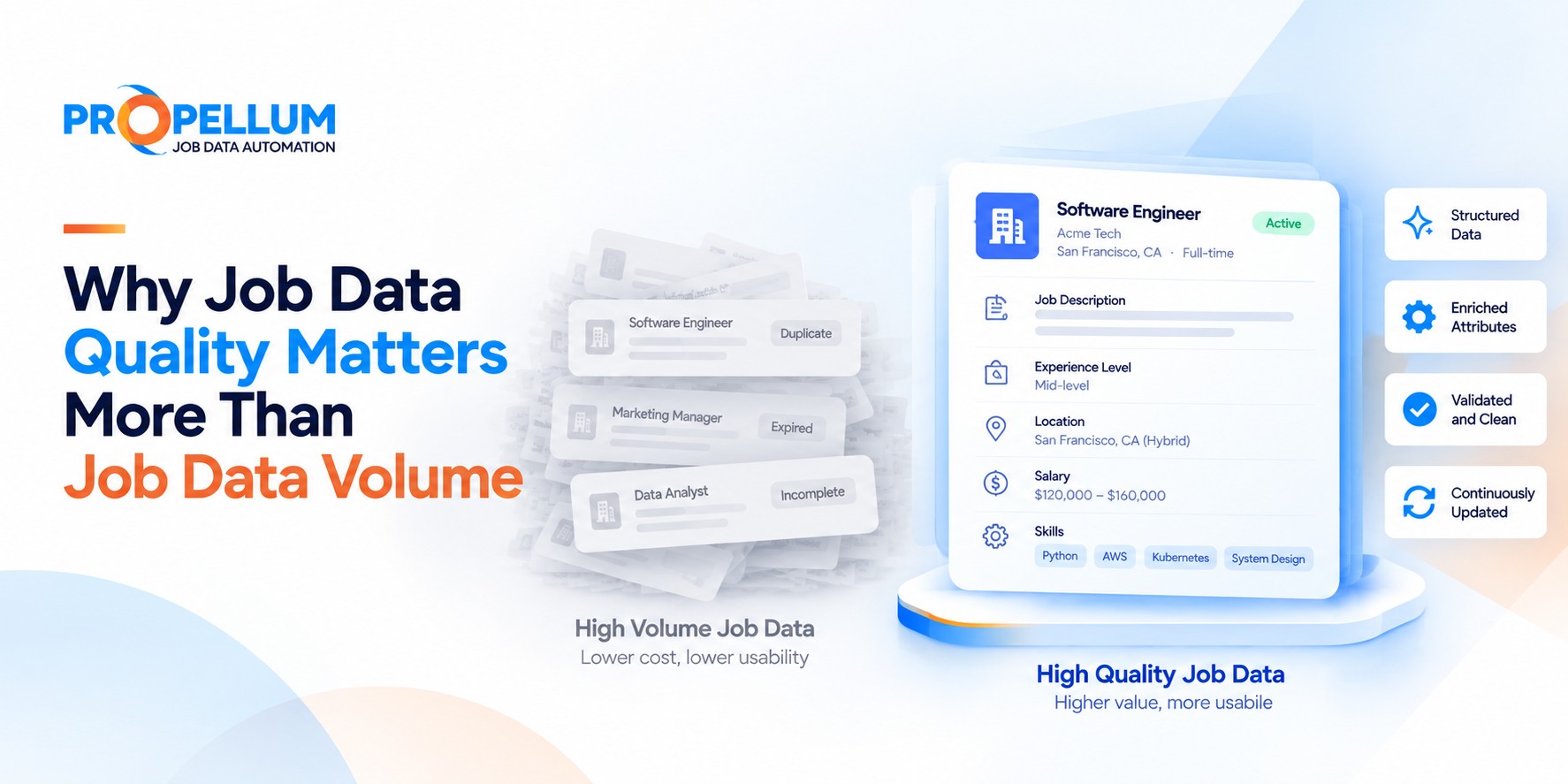
When buying job data, the biggest number often gets the most attention. 10 million job records sounds better than 2 million. A lower cost per record can also look like a better deal.
But volume alone does not tell you how useful the data actually is.
A large job posting dataset can contain duplicate listings, expired jobs, incomplete fields, inconsistent titles, outdated information and poorly structured descriptions. For companies building products around job data, quality can matter more than raw volume.
What Makes Job Data High Quality?
Job data quality is determined by much more than the number of records collected.
Useful structured job data typically depends on:
- Freshness: Are listings still active?
- Completeness: Are important fields available?
- Accuracy: Does the record reflect the original source?
- Consistency: Are titles, locations and employment types standardized?
- Uniqueness: Have duplicate listings been identified?
- Structure: Can the data be searched, filtered and analyzed?
- Enrichment: Can skills, salary, experience and other attributes be extracted?
This is particularly important when job data is being used by job boards, recruitment platforms, AI applications, sales intelligence systems or workforce analytics products.
Why Does High-Volume Job Data Cost Less?
There is nothing inherently wrong with inexpensive, high-volume job data. If you need broad raw coverage for exploratory analysis, it may be sufficient. The economics change when the data needs to be processed and maintained before it becomes usable. Continuously monitoring employer career pages, adapting to changing source structures, extracting listings, parsing descriptions, normalizing fields, identifying duplicates, validating records, and tracking job status all require infrastructure and ongoing operational work.
That work has a cost.
This is why two job data providers can offer very different prices for what appears to be the same product. The difference may not be the number of jobs. It may be what happens to those jobs before they reach you.
The Hidden Cost of Cheap Job Data
The purchase price is only one part of the total cost. A lower-cost dataset may require your team to add:
Data purchase → Cleaning → Deduplication → Parsing → Normalization → Validation → Enrichment → Maintenance
A higher-quality dataset can move more of that work to the provider:
Source → Collection → Processing → Quality control → Structured data → Delivery
The relevant metric is therefore not always cost per job. It can be cost per usable job. If your team spends significant engineering and operational time turning raw listings into usable job listing data, the initial price difference can become much less meaningful.
Where Job Data Quality Creates Value
The difference becomes particularly important when job data powers a product or business process. Job boards and aggregators need current, searchable listings.
HR tech platforms need structured information for matching, recruitment and talent intelligence. Sales teams can use hiring signals to understand company activity. Recruiting and staffing firms need reliable visibility into employer demand. AI and machine learning systems need consistent datasets that can be processed at scale. Workforce and labor market analytics require standardized information that can be compared across companies, locations, and industries. In each case, simply having more records does not necessarily create more value.
What Are You Actually Paying For?
When evaluating a job data API, job feed, or job data provider, look beyond the record count.
Ask:
- Where does the data originate?
- How frequently are sources monitored?
- How are duplicate jobs handled?
- How are expired jobs identified?
- Which fields are standardized?
- Are skills and salary extracted?
- How are source changes handled?
- How much processing will your team need to perform?
- Can the data be delivered through an API or feed?
These questions reveal what is actually included in the price.
How Propellum Approaches Job Data Quality
Propellum focuses on the infrastructure between the original job source and the final dataset.
We collect job listings from employer career pages and other employment sources, then apply crawling, extraction, parsing, normalization, enrichment, validation and deduplication before delivering structured job data through APIs, feeds and custom delivery models.
This means the value is not simply in collecting more listings. It is in reducing the work required to turn those listings into usable job data. For companies building job boards, recruitment technology, AI applications, sales intelligence products or workforce analytics solutions, that distinction can matter significantly.
The Real Question Is Not “How Much Data?”
The better question is: How much of the data can you actually use?
A high-volume dataset can give you more records. A quality-focused dataset can give you records that require less work before they can power your product. The right choice depends on your use case, but understanding the difference between data volume and data quality is essential when evaluating job data. The real value of job data is not how many records you receive. It is how much useful work those records can do.
FAQ
What is job data quality?
Job data quality refers to how accurate, complete, current, consistent and usable job records are. It can include factors such as freshness, duplicate handling, standardized fields, job status and enrichment.
Why is quality job data more expensive?
Quality job data can cost more because additional infrastructure and processing may be required for crawling, parsing, normalization, enrichment, validation, deduplication and continuous source monitoring.
Is high-volume job data always low quality?
No. High volume and high quality are not mutually exclusive. The important distinction is how much processing, validation and maintenance is performed on the data.
What should I look for in a job data provider?
Look at source coverage, freshness, structured fields, duplicate handling, job-status detection, enrichment, delivery options and the amount of processing your own team will need to perform.
Does Propellum provide structured job data?
Yes. Propellum provides structured job data collected from employer career pages and other employment sources, with processing that can include extraction, parsing, normalization, enrichment, validation and deduplication.