A company can tell you what it plans to do in a press release. Its hiring activity can tell you where it is investing. It can reveal what the company is actually doing.
When a company suddenly starts hiring software engineers, opening positions in a new country, building a sales team, or recruiting heavily for a particular skill, those job postings reveal something about where the business is investing. One listing may say very little. Thousands of listings, tracked over time, can tell a much bigger story.
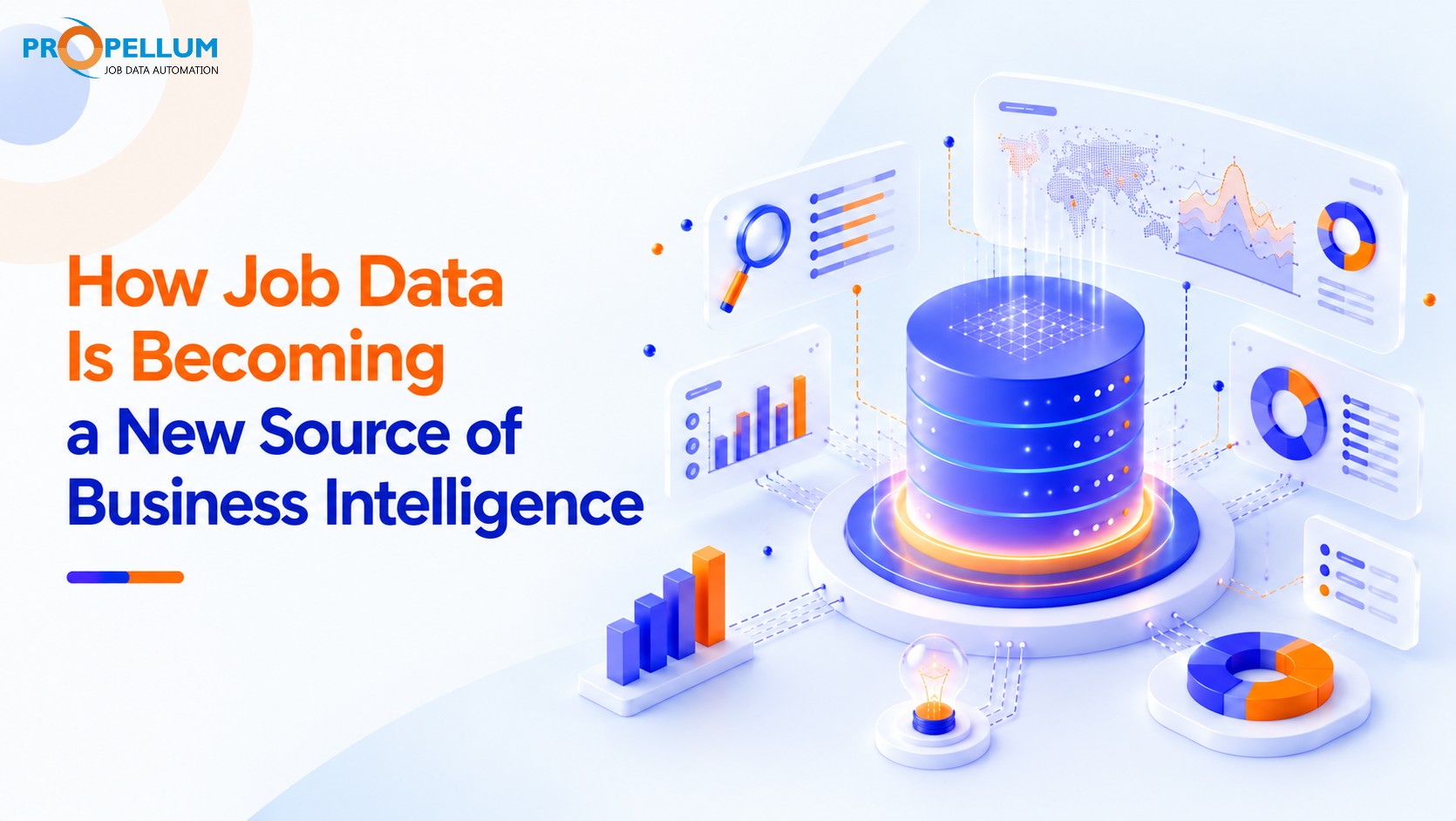
This is why job data is becoming more than recruitment information. When collected, structured, and analyzed at scale, it can become a source of business intelligence.
Job Data Contains More Business Signals Than It Appears
A job listing can reveal much more than a title and description. When collected consistently and structured correctly, it can expose patterns across companies, industries, locations, skills, seniority levels, and functions.
Consider a company that suddenly begins publishing roles for data engineers, machine learning specialists, and AI product managers. Looking at those listings individually tells you who the company is hiring. Looking at them together can reveal where the company is investing. The same applies at market level. Thousands of postings can show which skills are becoming more common, which locations are gaining demand, and which industries are expanding particular functions.
This is where Job Intelligence becomes valuable. Instead of treating each posting as an isolated record, organizations can analyze hiring activity as a continuous source of business signals.
Hiring Activity Can Reveal Company Strategy
Hiring plans often appear before strategic changes become obvious elsewhere.
A company expanding sales and customer success roles across a new geography may be preparing for market expansion. An increase in product, engineering, and design roles may indicate a major product initiative. A growing demand for specialized technical skills may signal investment in a new technology stack. These signals become particularly useful when tracked over time.
For example, a single cloud engineering vacancy tells you very little. A sustained increase in cloud, DevOps, and infrastructure roles across several quarters tells a different story. The value comes from the pattern, not the individual posting.
Why Raw Job Listings Are Not Enough
The challenge is that job data rarely arrives in a format ready for business analysis.
Different sources use different job titles, location formats, descriptions, employment types, salary structures, and skill terminology. The same company may publish similar roles across multiple career pages and applicant tracking systems. Duplicate listings and outdated postings can further distort analysis. This is why the data layer matters.
Job crawling collects the underlying listings. Job wrapping extracts information from different source structures. Job data enrichment adds usable attributes such as skills, categories, locations, and employment characteristics. Normalization then makes those records comparable across sources.
Without this process, an organization may have millions of listings but still struggle to answer basic questions reliably.
From Hiring Data to Competitive Intelligence
Once job data is structured, companies can compare hiring behavior across competitors and markets.
Which companies are increasing hiring in a particular function? Which organizations are building teams around a specific technology? Where are competitors expanding? Which skills are becoming strategically important within an industry? These questions turn job data into a form of competitive intelligence.
The same dataset can support sales intelligence. A company rapidly expanding its workforce may represent a stronger prospect than one with stable hiring activity. New locations, new departments, or sudden demand for particular capabilities can become signals for identifying accounts at the right moment.
For talent intelligence platforms, the use case is equally significant. Structured job data can help identify skill demand, emerging roles, talent movement, and changes in workforce requirements.
Freshness Determines How Useful the Intelligence Is
Business intelligence is only useful when the underlying information reflects current conditions.
Job listings change constantly. Positions are filled, removed, modified, reposted, or replaced. A dataset that is refreshed too slowly can create a misleading picture of hiring activity. That makes real-time or continuously refreshed job data particularly important for applications that depend on current signals.
A job data infrastructure should therefore do more than collect listings. It needs mechanisms for monitoring sources, detecting changes, removing stale records, identifying duplicates, validating application links, and delivering updated data through structured feeds or APIs.
This is where Job Intelligence depends directly on the quality of the underlying infrastructure. Better collection and enrichment create more reliable signals for the applications built on top of them.
The Same Job Data Can Power Multiple Products
One of the most interesting aspects of job data is that the same underlying dataset can support very different products.
A talent intelligence platform may use it to map skills and workforce demand. A sales intelligence platform can use hiring growth as an account signal. A market intelligence product can analyze hiring patterns across industries. An AI application can use structured job data to power search, matching, recommendations, or contextual analysis.
The difference is not necessarily the source data. It is how the data is structured, enriched, connected, and interpreted.
That is why job data infrastructure is becoming increasingly important beyond traditional job boards. The infrastructure creates a reusable data layer that different intelligence applications can build on.
Where Propellum Fits
Building this layer internally can require significant work across crawling, parsing, normalization, enrichment, validation, monitoring, and delivery.
Propellum provides the underlying job data infrastructure to support these workflows. Its capabilities span job crawling, job wrapping, structured data enrichment, normalization, validation, and delivery through feeds and APIs. This allows businesses to work with continuously updated job data without having to build and maintain every layer of the collection pipeline themselves.
For organizations building intelligence products, the value is not simply getting more job listings. It is getting structured, enriched, and usable data that can become part of a larger intelligence system.
That is the shift from job listings to Job Intelligence: moving from collecting vacancies to understanding what those vacancies reveal about companies, markets, skills, and economic activity.
The Business Value Is in the Signal
Job postings have traditionally been viewed as an endpoint of the recruitment process. Increasingly, they can be viewed as an input into a much broader intelligence ecosystem.
Hiring activity can reveal where companies are investing, which markets they are entering, what capabilities they are developing, and how workforce demand is changing. But extracting those signals requires more than scraping pages. It requires reliable job data infrastructure, enrichment, normalization, freshness, and structured delivery.
The companies that build around that foundation can turn job data into something far more valuable than a vacancy feed: a continuously updated source of business intelligence.
See how Propellum turns hiring activity into structured business intelligence →
Frequently Asked Questions
AI can process raw job descriptions, but structured job data makes it easier to consistently analyze titles, skills, companies, locations, salaries, and other attributes across large datasets.
Job scraping extracts information from websites. Job data automation goes further by continuously collecting, processing, validating, enriching, updating, and delivering that data so downstream systems can reliably use it.
A job data API can provide data for job search, AI matching, recommendation systems, talent intelligence, competitive intelligence, workforce analytics, and other applications that depend on continuously updated job information. Propellum’s API supports job retrieval, company-level queries, keyword and location filtering, and individual job details.