Most conversations we have with job boards start the same way.
“We need more listings.”
On the surface, it sounds straightforward. More supply should mean more traffic, more applications, more revenue. But once you go a level deeper, the pattern becomes obvious. Teams aren’t struggling to find jobs. They’re struggling to keep them.
That distinction matters.
Because what looks like a sourcing problem is almost always a job data pipeline problem.
Where things actually start breaking
Early on, most job boards grow through a mix of manual uploads, partner feeds, and a few integrations. It works, until it doesn’t.
You add more sources. Listings increase. But so does the complexity.
Different formats. Inconsistent fields. Duplicate jobs are showing up across sources. Feeds that stop updating without warning. Roles that expire but never get removed.
At that point, your team isn’t scaling listings. They’re maintaining them.
And maintenance doesn’t compound.
The realization most teams arrive at (eventually)
At some point, the focus shifts from “how do we get more jobs?” to something more fundamental:
“How do we make this system reliable?”
Because if your listings aren’t:
- Consistent
- Deduplicated
- Fresh
then adding more volume just amplifies the problem.
You don’t get a better product. You get a noisier one.
This is where we started thinking differently
At Propellum, we don’t look at job aggregation as a sourcing layer. We look at it as job data infrastructure. That shift changes how the entire system is designed.
Instead of asking, “Where can we get more jobs from?”, the question becomes:
“How do we build a pipeline that continuously produces clean, structured, and up-to-date job data?”
What that pipeline actually does (in practice)

Behind the scenes, the mechanics are straightforward but the execution is where most systems fail.
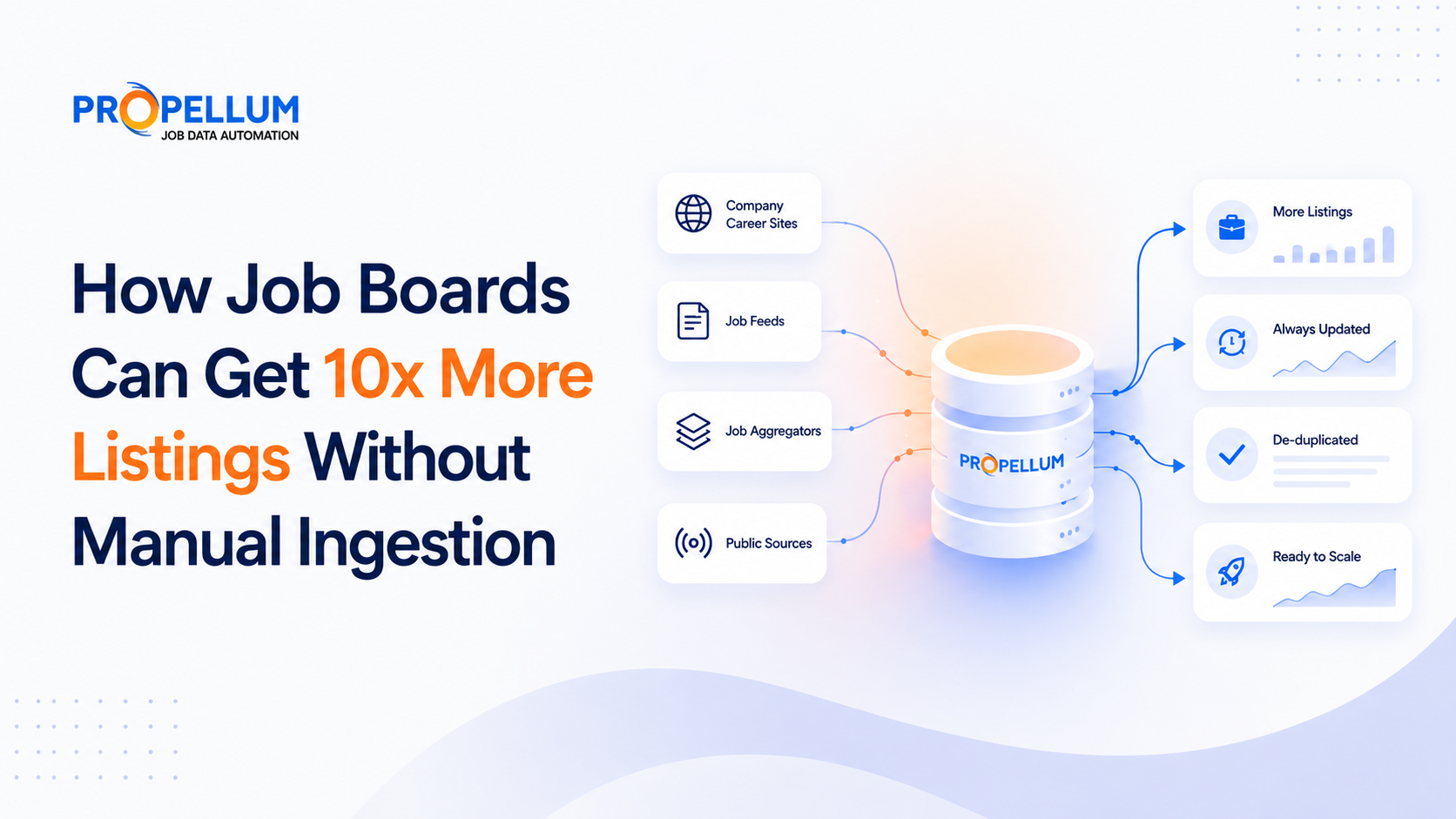
We continuously capture jobs directly from employer career sites and public sources, not as one-time pulls, but as ongoing streams. This is where job scraping for job boards and automated job listing aggregation come into play.
That raw data is then normalized into a consistent structure. Titles, locations, metadata, everything is standardized so it can actually be used inside your product, not just displayed.
From there, we handle deduplication. The same role often exists across multiple endpoints, and without reconciliation, it shows up multiple times. We merge those into a single clean listing.
And then comes the part most systems ignore, synchronization. Jobs change. They close. They get updated. We keep tracking those changes so your inventory stays accurate without manual intervention.
What you end up with isn’t just more listings.
It’s a system that helps you aggregate jobs from multiple sources and continuously improves how that data flows.
What changes once this layer is in place
The shift is noticeable almost immediately.
First, the operational load drops. Teams that were spending hours uploading, cleaning, or fixing data no longer need to. That effort disappears into the system. This is effectively how to automate job listings for job boards without increasing operational complexity.
Second, expansion becomes easier. Entering a new category or geography is no longer dependent on partnerships or manual sourcing. The pipeline handles it.
And third, this is often underestimated: the product itself improves.
Users see fewer duplicates. Listings are fresher. Application links work. Trust builds over time.
The SEO impact most teams don’t anticipate
A lot of teams come to us with a very specific goal: how to get more job listings.
But what they’re really trying to do is improve discoverability.
Search engines don’t just reward volume. They reward:
- Freshness
- Consistency
- Structured data
- Unique listings
If your system is manually driven, it’s difficult to sustain any of these at scale.
When the pipeline is automated and structured, these become natural byproducts—helping you increase job board listings without compromising quality.
Why this compounds over time
Manual systems scale linearly. If you want more listings, you need more effort.
Pipeline systems behave differently.
Once the infrastructure is in place, every improvement feeds back into the system. Better coverage leads to more data. More data improves matching, deduplication, and freshness. Which, in turn, improves performance.
That’s how you scale a job board without manual posting.
The takeaway – How to get more job listings
If you’re trying to figure this out, it’s tempting to keep looking outward, more sources, more feeds, more partnerships.
But the real leverage sits underneath all of that.
Because the constraint isn’t access.
It’s the system that turns that access into usable, reliable inventory through job feed integration, automated job listing aggregation, and a strong job data pipeline.
And once that system is built, growth stops being something you push and starts becoming something the platform generates on its own.