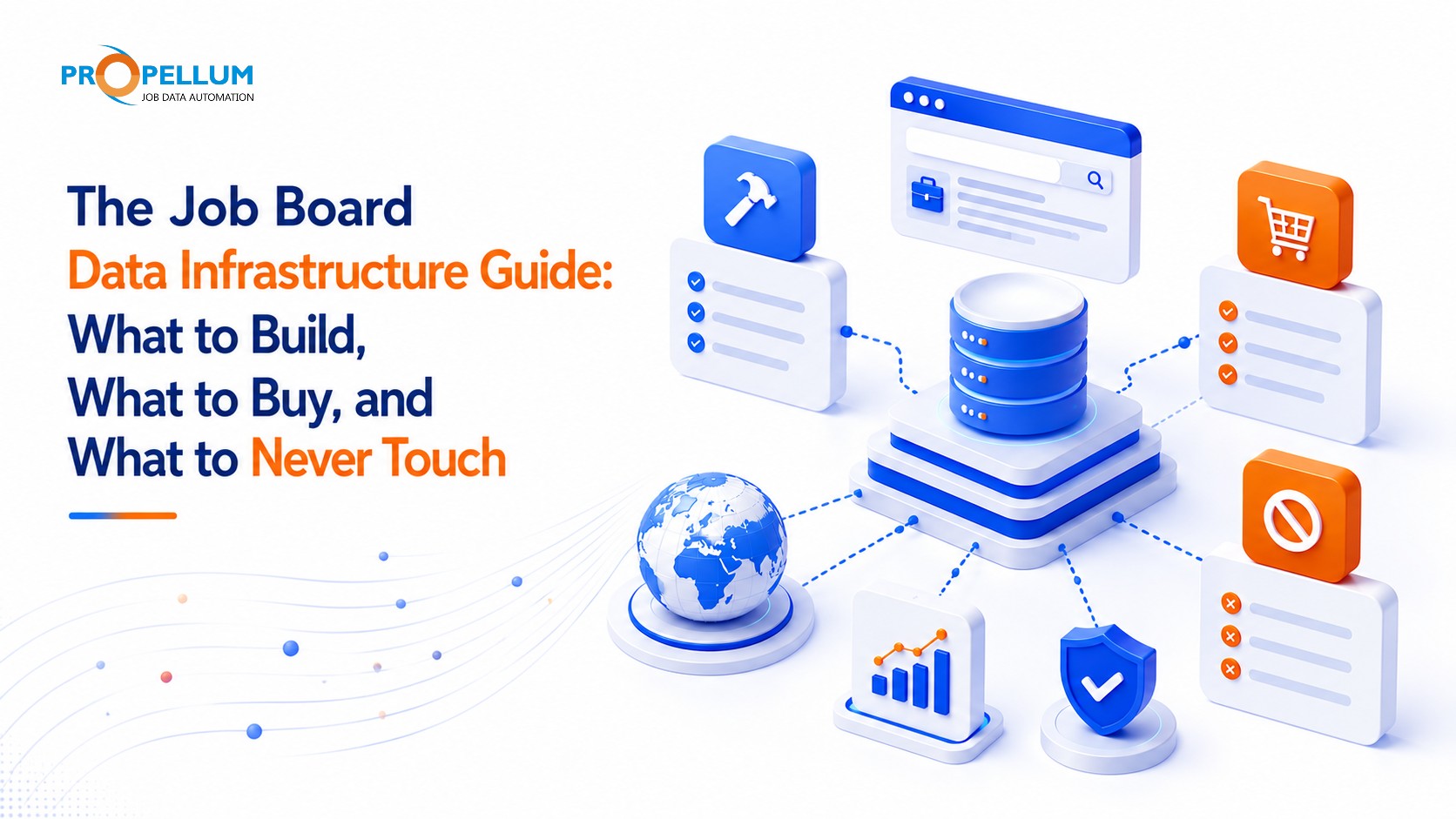
Every job board operator faces the same decision eventually. Which parts of the data stack to build in-house, which to hand to a vendor, and which to never attempt regardless of how strong the engineering team is.
Most boards get this wrong in the same direction. They build what they should buy and buy what they could build. The cost does not show up immediately. It shows up six months later, in engineering debt, degrading data quality, and a maintenance burden that compounds every time a source redesigns its career page or adds an anti-bot layer.
The decision is not complicated once the three categories are clear.
What to Build
The parts of your job board that reflect your product’s specific positioning belong in-house. No vendor builds these better than you can for your niche.
The front-end platform is yours. The search and filtering UI, the candidate experience, the employer dashboard, the design that makes your board feel different from every generic platform running the same template. This is your competitive differentiation. It is where your product decisions show up in the product. Building it yourself is not just reasonable. It is the only way to own the positioning that makes a niche board worth visiting over a generalist one.
Employer-facing tooling is yours. Direct posting workflows, featured listing logic, employer branding pages, application routing. These reflect your board’s specific relationship with the employers you serve and should be built to match that relationship rather than inherited from a generic vendor feature set.
What to Buy
The data infrastructure layer is the wrong thing to build. Not because it is technically impossible, but because the ongoing maintenance commitment makes it economically irrational for almost every board that is not itself in the business of selling data infrastructure.
Crawling employer career pages requires an active response to every career page redesign, every JavaScript framework migration, every new anti-bot system deployed by a large employer protecting their listings. A crawler that works correctly today begins degrading the moment a source changes. That change does not announce itself. Listings stop arriving, and the gap is invisible until it is large enough for someone to notice.
Enrichment requires training data at scale. Salary inference built on a thin dataset produces salary estimates that are wrong often enough to be worse than no estimate at all. Title normalisation built on a small taxonomy misses the variation that actually exists across thousands of employer naming conventions. These problems do not show up in a test environment with sample data. They show up in production, on real listings, in front of real candidates.
Deduplication, expiry detection, and structured feed delivery each carry their own maintenance cost on top of the crawling layer. Running all four in-house means owning an engineering surface that grows with every source added to the index and never shrinks.
The buy decision is not about capability. It is about where engineering time produces the most value. A team spending three days a week maintaining a crawler is a team not building the search experience that differentiates the board.
What to Never Touch
There is a third category that sits between building and buying: infrastructure that looks achievable and reveals its true cost only after significant investment.
Building a custom crawler for high-value sources with active anti-bot protection. Large employers protect their career pages specifically because scrapers exist. Getting through the protection once is a project. Staying through it as the protection evolves is a permanent commitment.
Attempting salary inference from scratch without historical data. The inference model is only as accurate as the dataset behind it. A board starting from zero has no dataset. By the time enough data exists to train a model worth using, the maintenance cost of the model itself has become another layer of infrastructure to own.
Running deduplication using exact-match logic on a large index. Exact matching misses most real duplicates because real duplicates are rarely identical text. The duplicates that slip through inflate listing counts and send candidates in circles. The ones that get incorrectly merged remove listings that should have been distinct. Fuzzy matching at scale requires the same kind of investment as the crawler: significant upfront build, permanent maintenance.
The Three-Question Test
Before any infrastructure decision, three questions cut through the noise.
Does this layer differentiate your product from competitors? If yes, build it. If no, keep reading.
Does it require ongoing maintenance from sources you do not control? If yes, the maintenance cost will compound indefinitely. That is a strong signal toward buying.
Does the failure mode hurt your end user directly? A broken search UI is visible immediately. A crawler returning stale data fails silently for days before anyone notices. The more invisible the failure mode, the more dangerous it is to own.
If the answer to the second and third questions is yes, it belongs in the buy column regardless of whether the first build looks straightforward.
Propellum is built for exactly that column: crawling, enrichment, deduplication, expiry detection, and structured delivery, maintained as production-grade infrastructure across more than a billion job records and 25 years, so the board operator owns the layer that actually differentiates their product and nothing else.
Get a free test feed. See what the data layer looks like when someone else owns the maintenance →
Frequently Asked Questions
The technical layer responsible for where job listings come from, how they are cleaned and structured, how duplicates are removed, how expired listings are detected, and how data is delivered to the board. Distinct from the front-end platform and search UI, which sit on top of it. The data layer determines what the board can show. The platform layer determines how it is shown.
For a small, known list of stable sources, a basic crawler is manageable. Past that threshold, the maintenance burden of keeping a crawler current across sources that change layouts, add JavaScript rendering, and deploy anti-bot systems compounds faster than most boards anticipate. A managed crawling service absorbs those changes rather than passing them to the operator’s engineering team.
A data vendor handles the crawling, enrichment, deduplication, and delivery pipeline. The board receives structured, ready-to-post listings rather than raw scraped data. The operator retains full control over the front-end experience, search logic, and employer relationships while removing the infrastructure maintenance from their engineering roadmap.
Four signals: engineers spending meaningful time on crawler maintenance rather than product features, listing freshness complaints from employers or candidates, duplicate listings appearing in search results, and salary or location filters returning inconsistent results. Any one of these indicates the data layer is constraining the product rather than enabling it.
The front-end experience, the search and filtering logic, and the employer relationship layer. These are where a board’s positioning lives. A vendor cannot build these better than an operator who understands their specific niche and audience.
- What Makes Propellum’s Job Data Reliable Enough for AI and Business Intelligence?
- How B2B Sales Teams Use Job Posting Data to Find Companies Ready to Buy
- What Job Data Can Tell Investors & Finance Professionals Beyond Traditional Financial Data
- Inside the Job Data Pipeline: From Employer Career Pages to Job Boards
- How Better Job Board Data Can Unlock Your Job Board’s Growth