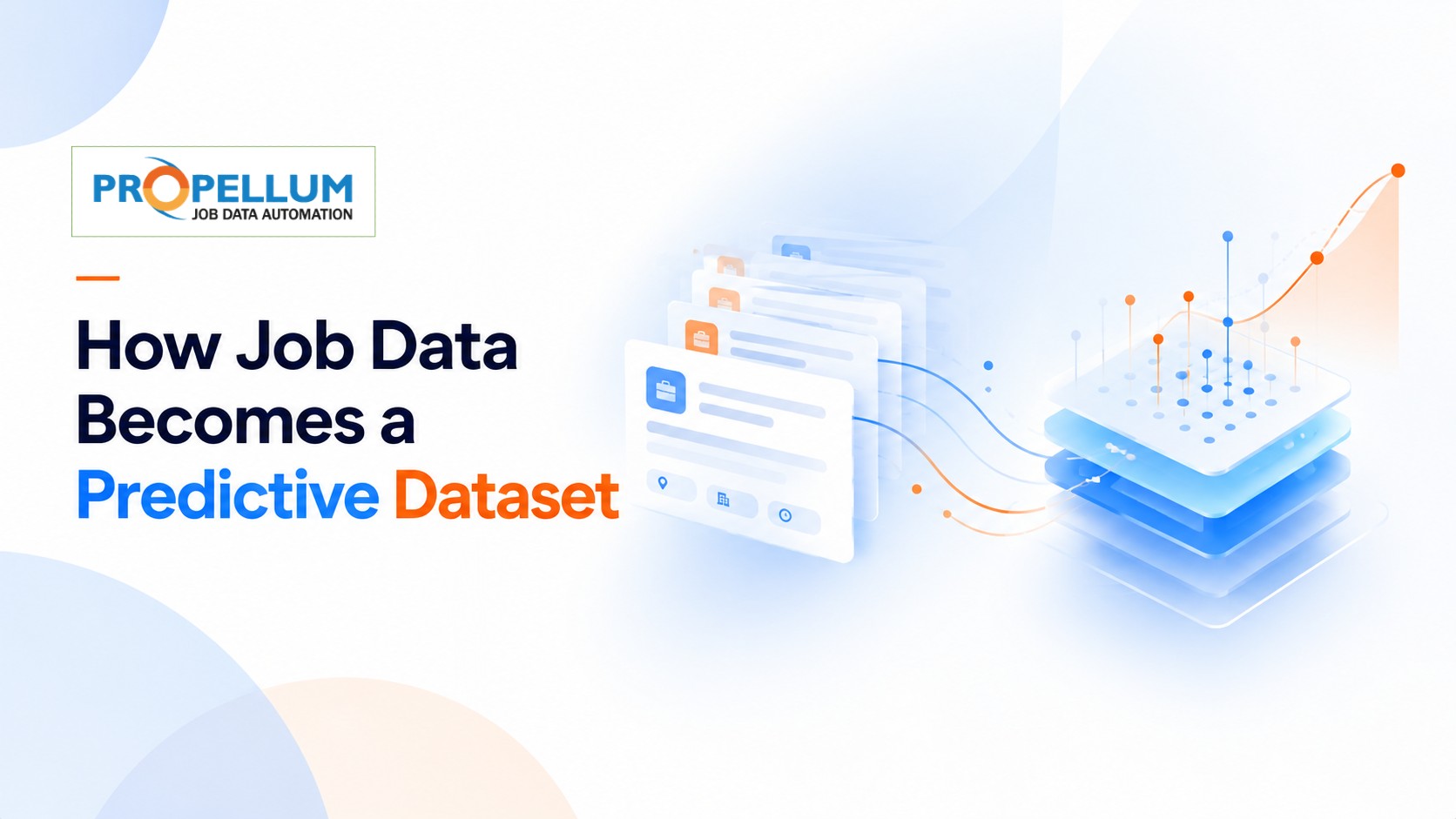
A job posting looks simple. A title, a description, a location, a few requirements, perhaps a salary range. But collect millions of those observations over time, structure them consistently, and something more valuable emerges: a dataset that can reveal how employers, occupations, skills, and labor markets are changing.
That is where job data for machine learning becomes more than a collection of job listings.
A Job Posting Is an Observation
Every job posting captures a small piece of employer behavior at a specific point in time. It tells you what a company is hiring for, where it is hiring, which skills it wants, what level of experience it expects, and sometimes what it is willing to pay. One posting rarely tells you much about the market.
Millions can. The difference comes from being able to compare those observations consistently. For an AI or analytics team, that means turning individual job postings into structured variables that a model can actually work with.
Title → occupation
Description → skills and requirements
Company → employer
Location → geography
Salary → compensation range
Posting date → time
The posting remains the source. The structure makes it useful.
Structure Turns Job Postings Into Data
Machine learning models cannot reliably learn from inconsistent job language. One employer might advertise a “Machine Learning Engineer.” Another might look for an “ML Engineer.” A third might describe the role as an “AI Engineer” while asking for many of the same capabilities.
The same problem appears across skills, locations, industries, and job functions. A useful job posting dataset therefore needs consistent representations of the underlying concepts.
That can include:
- Standardized occupations and job titles
- Normalized skills
- Consistent company identities
- Standardized geographic information
- Industry classifications
- Seniority levels
- Compensation attributes
- Posting and observation dates
Once these attributes are standardized, a model can compare like with like. More importantly, researchers can measure how those attributes change. This is where a structured job data provider becomes important. Propellum standardizes job titles, skills, companies, locations, industries, and other attributes so individual postings can be compared consistently across employers and over time.
History Creates the Signal
This is where a job dataset starts becoming predictive. A current dataset can tell you what employers are hiring for today. A historical dataset can show how that demand has changed. Consider a skill that appears in 2% of relevant job postings today. On its own, that number tells you very little. But if it appeared in 0.5% of postings two years ago, 1% last year, and 2% today, the trajectory becomes interesting. The same principle applies to occupations, industries, locations, compensation, and individual employers.
Historical job data can help answer questions such as:
- Which skills are accelerating?
- Which occupations are becoming more common?
- Where is hiring activity moving?
- Which industries are expanding into new capabilities?
- How quickly is demand changing?
The predictive value comes from these patterns over time, not from any individual job posting.
From Patterns to Features
Before a machine learning model can make predictions, the underlying observations usually need to become measurable features. Job posting data can support features such as:
- Hiring velocity – How quickly an employer, industry, occupation, or geography is adding job postings.
- Skill growth – How the frequency of a particular skill changes over time.
- Role emergence – When new job titles or occupational patterns begin appearing at scale.
- Geographic concentration – Where demand for a particular role or skill is becoming concentrated.
- Employer hiring intensity – How an individual company’s hiring activity changes over time.
- Compensation movement – How advertised salary ranges change across roles, skills, seniority levels, and locations.
These features transform millions of individual records into variables that analytical and machine learning systems can use.
Features Power Predictive Models
Once job data has been structured and converted into meaningful features, it can support a range of machine learning and predictive applications.
Forecasting labor-market trends – Historical hiring patterns can help models estimate how demand for occupations, skills, or industries may change.
Predicting skill demand – Models can identify patterns in the skills employers increasingly request and estimate which capabilities may gain importance.
Occupation classification – Job descriptions can be classified into standardized occupations or job families, even when employers use different titles.
Job matching – Structured skills, experience, occupation, and location attributes can provide richer inputs for matching candidates and jobs.
Workforce analytics – Historical employer demand can become an input for models that analyze workforce shifts, emerging roles, and changing talent requirements.
The important distinction is that job data provides the observations and features. The model determines what can be learned from them.
The Time Dimension Changes Everything
There is a fundamental difference between a dataset that contains today’s jobs and one that preserves how the job market looked over time. Current data tells you what exists. Historical data lets you study how it changes.
For machine learning, that distinction matters. Historical observations can be used to identify patterns, construct training windows, evaluate model performance against past conditions, and understand whether a signal persisted or disappeared. It also allows researchers to ask better questions:
- Did this skill actually accelerate, or did it simply spike for a few weeks?
- Did an occupation continue growing after its initial emergence?
- Did a hiring pattern appear across an industry or only at a handful of companies?
- Did the signal behave differently across regions?
Once these attributes are standardized, a model can compare like with like. More importantly, researchers can measure how those attributes change over time. That requires job data to remain structured and consistent across millions of observations. Propellum provides that underlying data layer, standardizing job titles, skills, companies, locations, industries, and other attributes so individual postings can be compared consistently across employers and over time.
What Makes a Predictive Job Dataset Useful?
Not every large job dataset is suitable for machine learning.
Consistency matters – Records need comparable structures and taxonomies across time.
History matters – Models need enough observations to learn patterns rather than isolated snapshots.
Granularity matters- Titles alone are rarely enough. Skills, occupations, employers, locations, compensation, and other attributes can provide important explanatory variables.
Coverage matters – A narrow sample can produce a narrow view of the labor market.
Point-in-time integrity matters – Historical records should preserve what was observable at the time rather than continuously rewriting past observations as taxonomies or company information change.
Ultimately, dataset quality determines what kinds of questions a model can answer reliably.
From Job Data to Predictive Intelligence
The progression is straightforward:
Job postings – Individual observations from employers
↓
Structured job data – Consistent occupations, skills, companies, locations, and attributes
↓
Historical dataset – Observations preserved across time
↓
Features – Measurable patterns such as hiring velocity, skill growth, and role emergence
↓
Machine learning models – Systems that classify, analyze, forecast, match, or detect patterns
↓
Predictive intelligence – A model’s view of what may happen next
The important part is what happens between the first and last step.
A job posting does not become predictive simply because it contains a lot of information. It becomes useful for predictive analysis when thousands or millions of observations can be structured, compared, connected, and measured over time.
The Dataset Is the Foundation
Predictive models are only as useful as the observations they learn from. For teams building AI models, labor-market analytics, workforce intelligence, or job-matching systems, job postings offer a continuously changing source of real-world employer behavior. The opportunity is not simply to collect more jobs.
It is to turn those jobs into a structured, historical, machine-readable dataset that makes patterns measurable and predictions possible. That is where job data becomes more than data. It becomes a foundation for understanding what the labor market could look like next. For teams building these datasets at scale, Propellum provides the underlying job data infrastructure, from employer job collection and normalization to structured delivery and historical coverage.
Structured job data can provide training and analytical inputs for models used in classification, job matching, skill analysis, forecasting, and labor-market intelligence.
A job posting dataset is a structured collection of job listings and their attributes, such as job title, description, skills, company, location, compensation, and posting date.
Historical data allows models and researchers to study how hiring patterns change over time, identify recurring signals, create training windows, and evaluate whether patterns persist.
Consistent structure, normalized occupations and skills, broad coverage, historical depth, and reliable point-in-time records make job data more useful for machine learning and AI applications.
Job postings can provide inputs for models that analyze or forecast labor-market trends. The predictive performance depends on the dataset, features, methodology, model, and validation approach.