Most comparisons treat these as the same category ranked by price and listing count. They are not in the same category, and buying the wrong one does not show up immediately. It shows up six months later, when your search results stop improving regardless of how many listings you add.
So here is the actual distinction, and how to tell which one your platform needs.
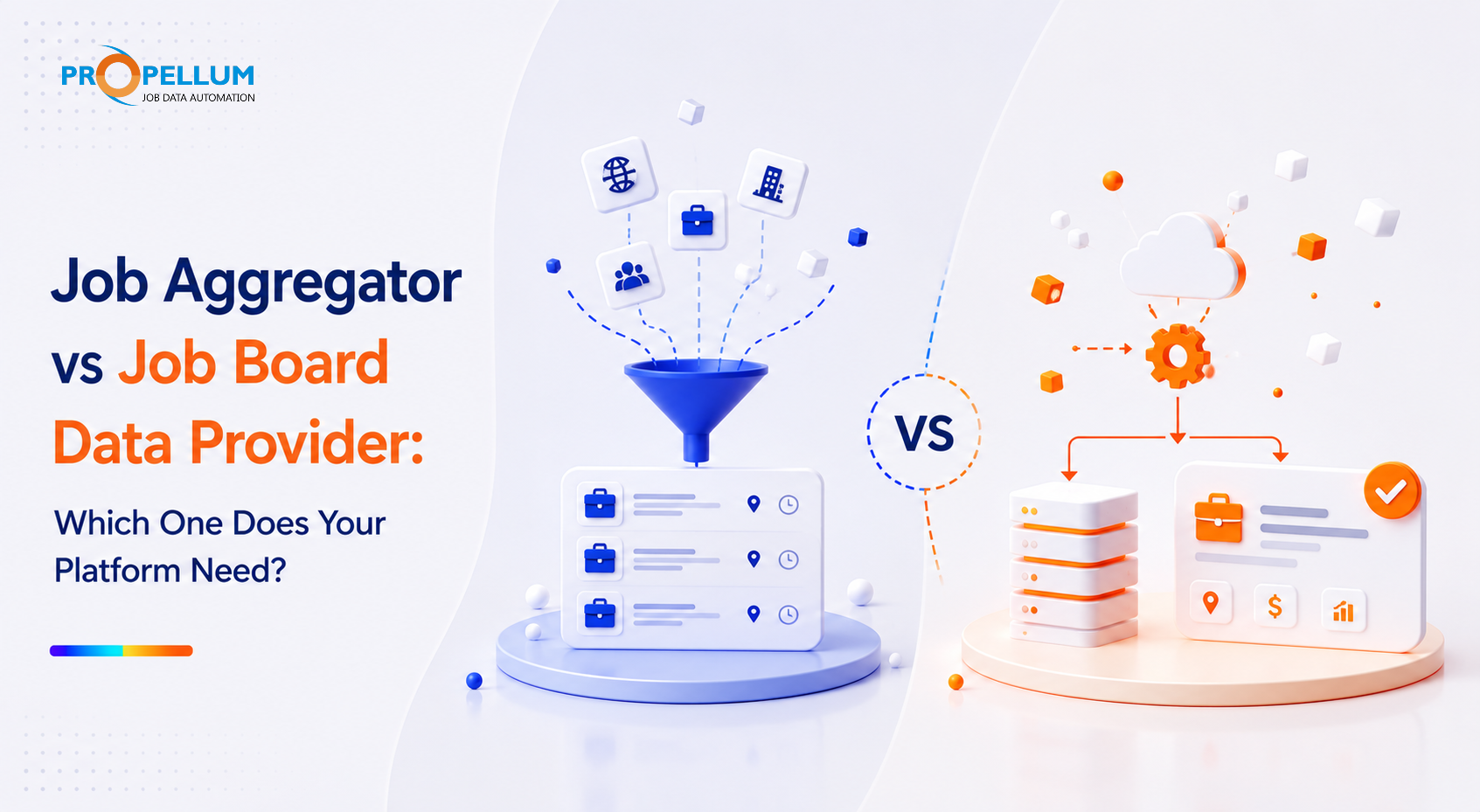
A job aggregator consolidates listings from multiple existing sources into one feed. A job board data provider collects, enriches, and delivers fully structured data from primary sources. The first solves a volume problem. The second solves an infrastructure problem.
What a Job Aggregator Does
A job aggregator pulls listings from other job boards and brings them together into a single feed or interface. The structuring at this layer is minimal. Titles, locations, and salary stay in whatever format the original source used. Duplicates and freshness limitations from upstream sources come along for the ride.
None of that is a criticism. Consolidation is exactly what an aggregator is built for. If you need listing volume on your platform quickly and your product does not depend heavily on search precision or salary filtering, an aggregator solves that problem efficiently and without significant infrastructure investment.
What a Job Board Data Provider Does
A job board data provider works at a completely different layer. Instead of pulling from other boards, it collects directly from employer career pages through its own crawling infrastructure. Every record then passes through a full enrichment pipeline: title normalization, location geocoding, salary estimation, skills extraction, and deduplication, all before it ever reaches your platform.
The output is not raw listings you process yourself after delivery. It is structured, board-ready data configured to your schema. An aggregator consolidates what already exists. A data provider produces clean, structured data that did not exist in that form before the pipeline ran. That difference matters more the further your product scales.
How They Compare
| Job Aggregator | Job Board Data Provider | |
| Data source | Other job boards | Direct employer career pages |
| Structuring | Minimal, original formatting retained | Full enrichment before delivery |
| Deduplication | Often limited | Built into the pipeline |
| Freshness | Depends on upstream source lag | Near real-time from the original source |
| Best for | Increasing listing volume quickly | Powering search, filtering, and matching reliably |
How to Know Which One You Need
The simplest test: do you need listings to exist on your platform, or do you need listings that actually work inside it?
If volume is the priority and your core features do not depend on normalized data, an aggregator gets you there faster and with less infrastructure investment. That is a legitimate answer for a lot of early-stage boards, and there is no reason to over-engineer the data layer before the product has found its footing.
If your platform’s competitive position depends on search accuracy, reliable salary filters, or location-based matching that job seekers can actually trust, you need enriched, structured data underneath those features. Raw aggregated listings will not support them reliably at scale, and the gap becomes obvious the moment a candidate runs a salary filter against fields that are mostly blank.
Most boards that start with aggregation and scale past an early stage eventually hit the same wall. The data layer needs to be infrastructure, not just consolidation, for the product to keep improving rather than plateauing on data quality.
Propellum operates as a job board data provider: direct crawling of employer career pages across 15+ countries, full enrichment on every record, delivered into your platform’s schema. Built on 25+ years of job data and over a billion records processed.
Request a free test feed in 24 hours →
A job aggregator consolidates job listings from multiple external sources, often other job boards, into a single feed or searchable platform. Its primary function is bringing together listings that already exist elsewhere. Data structuring is typically minimal, with listings retaining the formatting of their original source.
A job board data provider handles the full pipeline of job data collection, enrichment, and structured delivery. Rather than consolidating existing listings, it collects directly from employer career pages, then applies enrichment including title normalization, location geocoding, salary estimation, and skills extraction before delivering board-ready records.
It depends on what your platform needs from its data. If you need to increase listing volume quickly, an aggregator addresses that efficiently. If your product depends on accurate search, salary filtering, or location-based matching, you need the structured, enriched data a data infrastructure partner delivers. Many platforms start with aggregation and move to infrastructure as data quality becomes a competitive factor.
A job board is a platform where job seekers search and apply for roles. A job aggregator is a data source that consolidates listings from multiple external sources. Many job boards use aggregation as one component of their data strategy alongside direct employer submissions and a structured data feed.
Yes. Some platforms use aggregation to supplement volume in specific categories while relying on a data provider for the core structured index powering search and filtering. The key is understanding which layer each source is serving, since aggregated and enriched data are not interchangeable inputs for the same features.
Aggregators consolidate listings that have already passed through other sources, inheriting whatever quality, freshness, and duplication issues exist upstream. Data providers collect directly from original sources and apply a dedicated enrichment pipeline including normalization, deduplication, and expiry detection, which aggregators typically do not run.
- Why Job Data Quality Matters More Than Job Data Volume
- What Makes Propellum’s Job Data Reliable Enough for AI and Business Intelligence?
- How B2B Sales Teams Use Job Posting Data to Find Companies Ready to Buy
- What Job Data Can Tell Investors & Finance Professionals Beyond Traditional Financial Data
- Inside the Job Data Pipeline: From Employer Career Pages to Job Boards