Every job board starts with manual processes. Someone finds an employer’s career page, copies the listing, formats it, and posts it. At ten listings a week this is manageable. At ten thousand listings a week, it has become a structural problem, and at the scale a competitive job board actually needs to operate, manual processing is not slow. It is impossible.
AI job data processing automates the three stages of the job data pipeline: collection from employer career pages, enrichment of incomplete or unstructured records, and delivery into the board’s schema. What takes a team of data operators days to process manually, an AI pipeline processes in minutes, at unlimited scale, with higher accuracy and without the maintenance burden that compounds every time a source changes.
Why Job Data Is the Hardest Data to Process Manually
B2B data decays at roughly 30% per year. Job data decays in hours. A listing posted on a Monday morning can be filled and removed by Wednesday. A manual processing team working through a weekly batch cycle will post that listing, leave it live, and have no mechanism to detect that the role no longer exists.
This decay rate is what makes manual job data processing structurally different from manual processing in almost any other data category. The volume is continuous. The freshness requirement is near-real-time. And every source has its own formatting conventions, which means every record requires individual handling rather than a replicable template.
The Three Stages Where Manual Processing Breaks Down
Stage 1: Collection
Manual job data collection means a human visiting employer career pages, identifying new listings, and extracting the relevant fields. A team can cover a known list of sources on a regular schedule. What it cannot do is adapt when an employer redesigns their career page mid-cycle, handle the JavaScript-rendered pages that a standard HTTP request returns blank, or respond to anti-bot systems that block repeated requests from the same IP range.
An AI job crawler handles all three. Adaptive pattern recognition identifies the new page structure without manual reconfiguration. Headless browser rendering handles JavaScript content. And distributed crawling infrastructure manages request patterns to avoid triggering blocking mechanisms. The result is continuous, automatic collection that the manual equivalent would require a permanent engineering team to approximate.
Stage 2: Enrichment
Approximately 70% of job postings do not include a disclosed salary. Employer job titles follow internal naming conventions that a job seeker searching “Senior Software Engineer” will not match against “Sr. SWE II” without normalisation. Locations arrive as human-formatted strings that a radius-based filter cannot query until they are geocoded.
Manual job data enrichment means a data operator reviewing each record, inferring the missing fields, standardising the inconsistent ones, and flagging the ones too ambiguous to resolve. At small volume, this produces high-quality output. At the volume a job board at scale ingests daily, it produces a backlog that grows faster than any team can process it.
AI-based enrichment applies NLP classification, salary inference models, taxonomy mapping, and geocoding to every record automatically, producing completion rates of 65 to 80% on salary fields where the manual equivalent can only pass through whatever the employer disclosed.
Stage 3: Delivery
Manual delivery typically means a scheduled file export: a CSV or XML produced at a fixed interval and imported into the board’s database. The process is straightforward and the interval is the problem. A 24-hour delivery cycle means listings that go live at the source in the morning do not appear on the board until the following day. Listings that close between cycles remain visible on the board until the next scheduled import removes them.
An automated real-time job data pipeline delivers listings continuously, maps directly into the board’s schema, and removes closed listings within hours of source detection rather than at the next scheduled cycle.
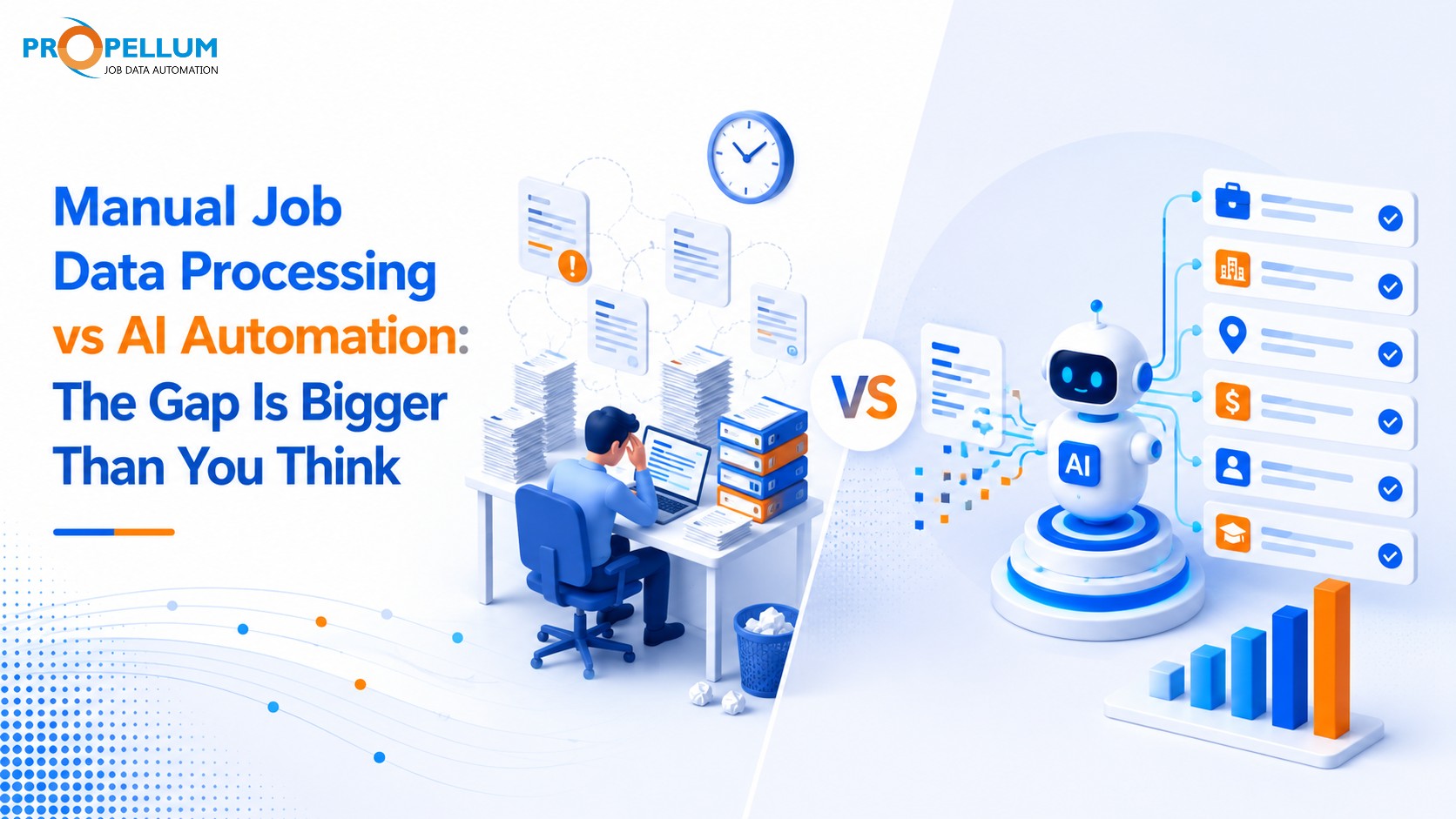
Manual vs AI Job Data Processing: The Full Comparison
| Dimension | Manual Processing | AI Job Data Processing |
| Speed | Days to weeks per batch cycle | Minutes per record, continuous |
| Accuracy | Dependent on operator consistency | ML models trained on 1B+ records |
| Scale | Limited by headcount | Unlimited; no marginal cost per record |
| Salary completion | Source-dependent only (~30%) | AI inference: 65 to 80%+ |
| Title normalisation | Manual standardisation; high error rate at volume | Taxonomy-based; hundreds of variants per role |
| Freshness | Batch cycle lag; hours to days old on delivery | Continuous; minutes from source to board |
| Expiry detection | Passive; relies on source removing the listing | Active re-verification on every crawl cycle |
| Maintenance | Permanent; every source change requires manual intervention | Provider-managed; adaptive to source changes |
| Cost model | Full engineering and operator team | Provider fee; no internal infrastructure |
What the Gap Means for a Job Board Operator
A job board making the manual-to-AI transition does not get a faster version of the same process. It gets a different category of capability. The engineering team that was maintaining crawlers and fixing broken extractors moves onto product work. The data backlog that was running behind every refresh cycle disappears. The salary and title fields that were patchy at best become consistently populated.
The scale argument matters most. A manual pipeline that works adequately at 50,000 listings does not scale to 500,000 with more staff. The operational model breaks before the headcount ever catches up. An AI pipeline that handles 50,000 listings handles 5,000,000 without a material change in the underlying infrastructure.
Propellum’s AI job data processing pipeline has operated at this scale for 25 years, processing over a billion job records across 15 countries. The enrichment models are accurate because the training data behind them is not a sample. It is the full history of how employers across every major market have described every major role category since before most job boards existed.
See what AI-processed job data looks like for your board. Get a free test feed in 24 hours →
Frequently Asked Questions
The automated collection, enrichment, and delivery of job listing data using machine learning and NLP rather than manual operator review. AI job data processing covers three stages: crawling employer career pages to collect raw listings, enriching incomplete or unstructured records with normalised titles, geocoded locations, and inferred salary data, and delivering structured output continuously into the receiving platform’s schema.
A pipeline in which human operators collect job listings from employer sources, standardise and enrich the fields manually, and deliver the processed data to the job board on a scheduled basis. Manual processing is adequate at small scale and breaks as volume increases, because the time required to process each record does not reduce with scale the way an automated pipeline does.
At small volume, a careful manual operator can produce higher accuracy on individual records. At scale, the error rate of manual processing increases as volume and time pressure grow, while AI models trained on large datasets maintain consistent accuracy regardless of volume. On salary inference specifically, manual teams can only process what employers disclose. AI models infer salary ranges for the 70% of listings where employers do not disclose, producing completion rates of 65 to 80% versus roughly 30% for pass-through manual processing.
Headcount, engineering maintenance, and lag time. A manual pipeline requires operators proportional to listing volume, engineers to maintain source extractors as career pages change, and accepts a freshness lag of hours to days between source and delivery. As listing volume grows, all three costs increase proportionally. An AI pipeline replaces all three with a provider fee that does not scale with volume.
Automated delivery operates as a continuous pipeline: new listings detected at the source are enriched and delivered to the board within minutes, and listings removed at the source are detected and withdrawn from the board within hours. Scheduled file delivery operates at a fixed interval, meaning the board is always some number of hours behind the source, and closed listings accumulate between cycles. The practical difference is the gap between what the board shows and what is actually live at the employer.
- Why Job Data Quality Matters More Than Job Data Volume
- What Makes Propellum’s Job Data Reliable Enough for AI and Business Intelligence?
- How B2B Sales Teams Use Job Posting Data to Find Companies Ready to Buy
- What Job Data Can Tell Investors & Finance Professionals Beyond Traditional Financial Data
- Inside the Job Data Pipeline: From Employer Career Pages to Job Boards