A job description is written for a human being. It uses natural language, varies in structure across every employer, and contains information in whatever order the hiring manager chose to present it. That is entirely appropriate for its intended audience. It creates a significant problem for every system that needs to treat job data as structured, queryable information.
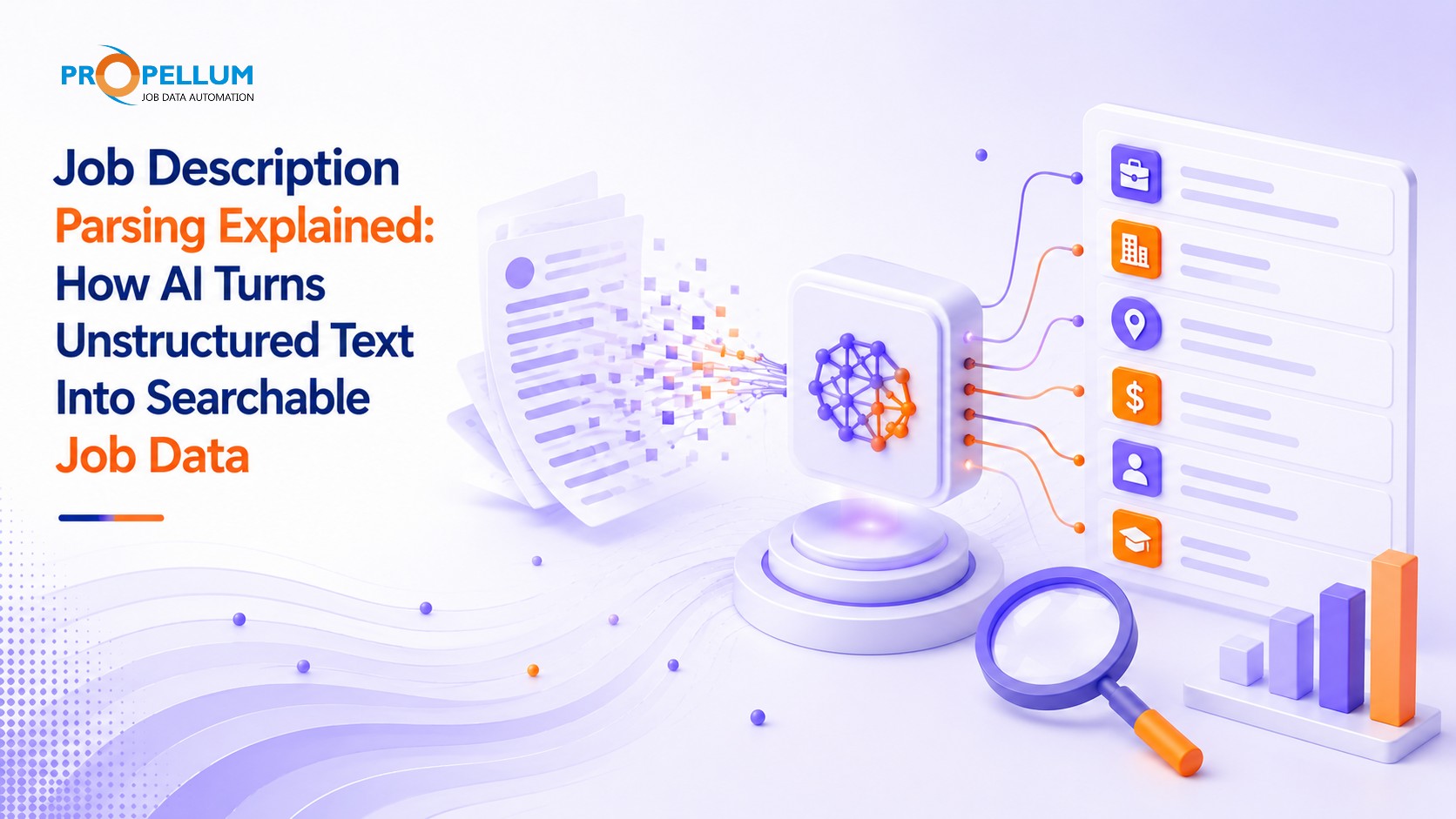
A job description parser is a system that reads free-form job posting text and extracts structured data fields from it: job title, required skills, location, salary range, experience level, employment type, and industry classification. The output is not the original text reformatted. It is a set of machine-readable fields that a search engine, filter system, or matching algorithm can query directly.
Understanding what parsing does, and where it sits in the broader data pipeline, is what separates a job board operator making informed infrastructure decisions from one inheriting the consequences of uninformed ones.
Why Job Descriptions Arrive Unstructured
Employers write job descriptions to attract candidates, not to feed data infrastructure. The same role can be described as “Senior Software Engineer,” “Sr. SWE,” “Software Engineer III,” or “L5 Engineer” depending entirely on a company’s internal convention. Skills are embedded in paragraphs rather than listed in fields. Salary appears in some descriptions and is absent from most. Location might read as “London, UK,” “Greater London area,” “Hybrid, 3 days in office,” or simply “Remote.”
None of this is wrong from the employer’s perspective. It becomes a structural liability the moment a job board attempts to power a consistent search experience across thousands of sources, each with its own formatting approach.
What a Job Description Parser Actually Does
Parsing works in three sequential stages, each building on the output of the previous one.
The first stage is text extraction: retrieving the raw prose from the source, whether from an HTML page, a PDF, or an API response. This stage is technically straightforward but depends entirely on a crawler capable of handling the variety of formats employer career pages use, including JavaScript-rendered content that a simple HTTP request will not surface.
The second stage is NLP classification: reading the extracted text and identifying which passages correspond to which data fields. This is where the meaningful work happens. A classification model trained on large volumes of job data learns that “5 years of experience with Python required” and “Python background preferred” both reference the same skill but with different necessity, seniority context, and weighting. Keyword matching cannot make that distinction. Classification can.
The third stage is taxonomy mapping: taking the extracted values and normalising them against a standard taxonomy. A raw extracted title of “Sr. SWE II” maps to “Senior Software Engineer.” A location string of “NYC area” maps to New York City with geocoded coordinates. A salary range stated as “£60k-£75k DOE” is standardised into a consistent schema, allowing it to function in a salary filter rather than sitting as an unstructured text field that the filter cannot read.
Where Parsing Fits in the Data Pipeline
Parsing is not a standalone process. It sits within the broader job data enrichment pipeline that transforms raw sourced data into board-ready structured records. Without parsing, enrichment has nothing meaningful to work with. Without enrichment, parsed values have no consistent taxonomy to map to. The two are interdependent, and both are upstream of the three data fields: title, location, and skills, which ultimately determine whether a listing surfaces in search.
Keyword Matching vs Job Description Parsing
| Keyword Matching | Job Description Parsing | |
| Method | Scans for term presence in text | Extracts structured fields using NLP classification |
| Title handling | Matches exact string only | Normalises variants to consistent taxonomy |
| Skills | Present or absent | Required vs preferred, with seniority context |
| Location | Matches text string | Geocoded, structured, radius-queryable |
| Salary | Passes through only when present | Structured range; inferred where absent |
| Search accuracy | Dependent on exact text match | Returns semantically equivalent results |
The practical consequence of the difference is visible in search quality. A board relying on keyword matching for a search of “Senior Product Manager in Bangalore” returns only listings where both that exact title format and that exact location string appear. A board with parsing running before the listing reaches search returns every senior product manager role in Bangalore regardless of how the employer described either.
What Parsing Cannot Do Without Quality Data
Parsing improves the structure of job data. It does not improve the underlying accuracy of what an employer wrote. A job description that incorrectly states a role requires ten years of experience with a technology that did not exist ten years ago will parse that requirement faithfully. Parsed data is structured. It is not validated. Validation, duplicate detection, and expiry verification are separate pipeline stages that operate on parsed output rather than replacing it.
This distinction matters when evaluating any data provider’s enrichment claim. Parsing and enrichment are meaningful capabilities. They are necessary steps in the pipeline to board-ready structured data. They are not the entirety of it.
Propellum’s data pipeline applies NLP-based job description parsing as a standard step before delivery, producing structured, taxonomy-mapped records across title, location, skills, salary, and employment type fields, built on patterns from more than a billion job records processed across 25 years and 15 countries.
See what parsed, structured job data looks like for your board. Get a free test feed in 24 hours →
Frequently Asked Questions
A system that reads free-form job posting text and extracts structured data fields from it, including job title, required and preferred skills, location, salary range, experience level, and employment type. The output is machine-readable data that a search engine or matching algorithm can query, rather than unstructured prose that only a human reader can interpret.
Rule-based parsing systems rely on fixed patterns and break when employer language varies. AI-based parsing using NLP classification learns from large volumes of job data to identify field boundaries and values regardless of how an individual employer chose to phrase them. This produces higher extraction accuracy across the variety of formats that appear across thousands of employer career pages.
Keyword matching identifies whether a term appears in a text. Parsing identifies what role that term plays: whether a skill is required or preferred, what seniority level a title implies, what a location string resolves to when geocoded. The difference is the distinction between presence and meaning, and it determines whether a job board’s search experience returns relevant results or merely text-matched ones.
The core fields are job title, skills (with required versus preferred distinction), location, salary range, employment type, experience level, and industry or job category. More sophisticated parsers also extract application deadlines, team size context, and technology stack signals from the description body.
Search engines and filter systems query structured fields, not prose. When skills are buried in free-text description paragraphs rather than stored as structured tags, a skills filter cannot find them. When a title has not been normalised to a taxonomy, a search for “Senior Software Engineer” will not surface listings where the employer wrote “Sr. SWE” or “L5 Engineer.” Parsing is the step that converts employer-authored prose into data that search infrastructure can actually use.
- Hiring Signals vs. Buying Intent: What Job Data Can Tell You and Who Can Use It
- Job Feed SLAs: 7 Metrics Every Job Board Should Demand From a Data Provider
- Google for Jobs: 5 Data Issues That Can Limit Listing Visibility for Job Boards
- A Guide to Comparing Job Markets Across Countries Using Job Posting Data
- More Job Postings Don’t Always Mean More Hiring: How to Interpret Job Data Correctly