Before unpacking any further, it’s worth answering a question that executives and developers keep asking: how do job aggregators get their jobs?
Most job boards don’t have direct relationships with every employer. Instead, they rely on a job market intelligence platform, like Propellum, that continuously crawls tens of thousands of employer career pages, extracts raw job listings, enriches the data (adding missing fields like location, seniority level, and required experience), and delivers clean, structured feeds in formats like JSON, XML, or CSV.
Propellum’s proprietary AutoExtract algorithm pulls live job listings directly from employer websites, not syndicated copies, but primary-source data. That means the information is fresher, more complete, and structurally consistent enough to be analyzed at scale.
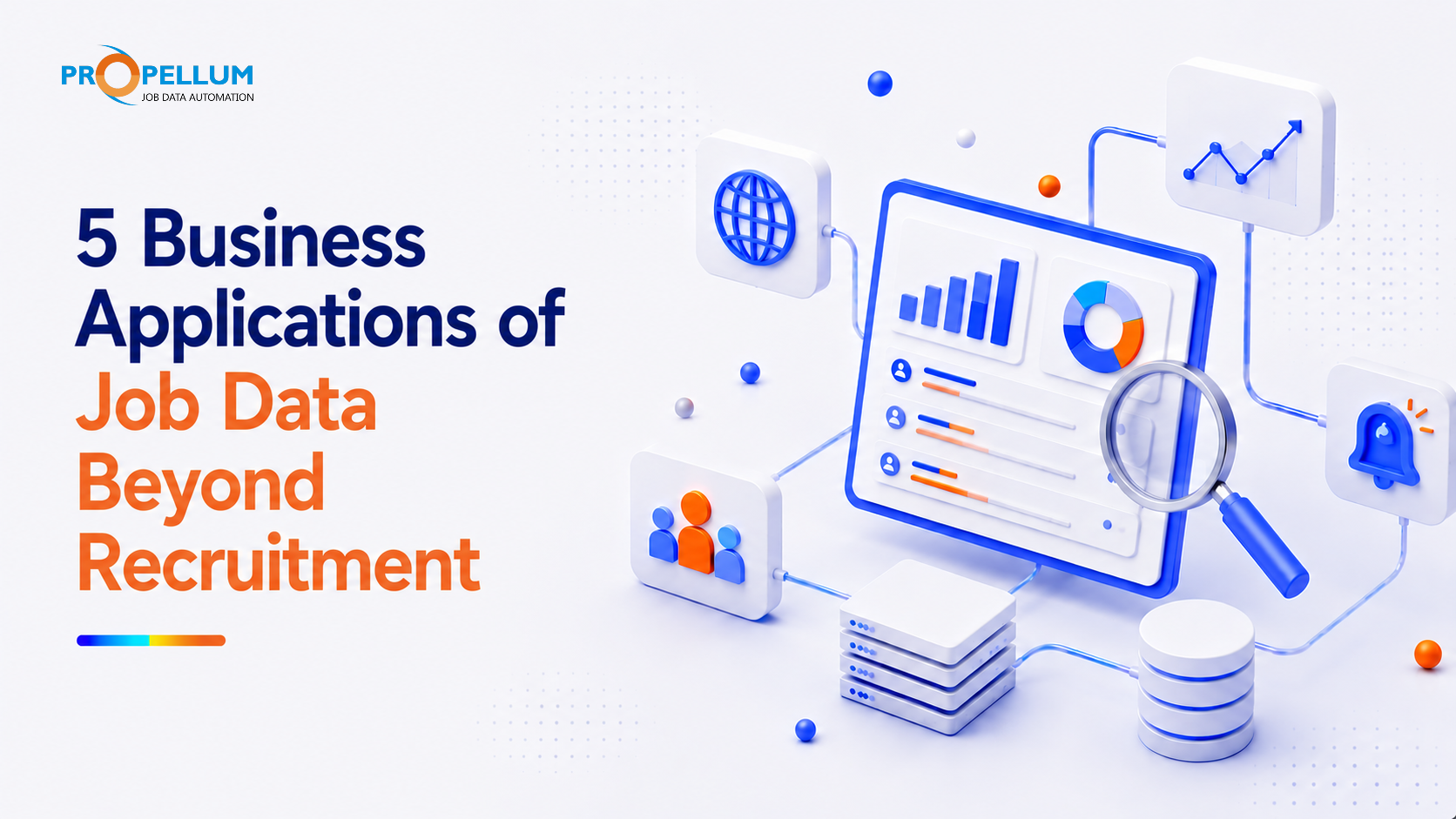
That structured data doesn’t have to stop at the job board. Here are five high-value ways organizations are using it beyond traditional recruitment.
1. B2B Sales Intelligence: Hiring Signals as Purchase Intent
Who uses it: Sales teams, SDRs, GTM leaders, revenue operations
When a company posts 15 new SDR roles in a quarter, that’s not just an HR decision, it’s a buying signal. Companies scaling their sales teams are also in the market for CRMs, sales engagement tools, and outbound platforms. When finance and compliance roles spike, it often means an IPO or regulatory shift is underway.
Hiring signal data is now a standard input for B2B sales prospecting because job postings are one of the most honest signals a company produces. Unlike press releases, job descriptions reveal actual operational priorities, companies spend real money on every hire, so the intent behind each posting is genuine.
How job aggregation powers this: Propellum’s infrastructure crawls employer career pages at high frequency, the same mechanism that keeps job boards current. That same freshness is what makes the data actionable for sales teams. A stale job posting from three weeks ago is weak signal. A posting detected within 24 hours of going live is a strong one.
What this looks like in practice:
- A SaaS company targeting HR tech buyers monitors for surges in “HRIS Administrator” or “People Operations” postings as a trigger for outbound
- A staffing agency identifies companies with 30%+ headcount growth in engineering as prime targets for contract talent
- An ATS vendor uses hiring volume by department to prioritize enterprise accounts showing rapid sales team expansion
Key insight: Companies increasing job postings by 30% or more in a quarter are significantly more likely to purchase new software. The job data is the signal; the sale is the outcome.
2. Competitive Intelligence: See What Competitors Are Building Before They Announce It
Who uses it: Product strategists, corporate intelligence teams, VC analysts
Job postings reveal organizational priorities months before product announcements or press releases. If a competitor starts hiring a cluster of machine learning engineers alongside a “Head of AI Product,” they’re building something. If they post five roles in a new geographic market, they’re expanding there.
This application of recruitment data as a service is quietly one of the most valuable uses of job data in enterprise strategy, and one of the least talked about.
Signals analysts look for:
- New skill clusters appearing in job descriptions (e.g., a fintech suddenly hiring for “regulatory compliance in EU markets”)
- Seniority level shifts (posting VPs and Directors instead of individual contributors signals a strategic build-out)
- Volume spikes in specific departments or geographies
- Sudden drop in postings, often a signal of a hiring freeze, restructuring, or capital constraint
Because Propellum delivers enriched, structured feeds with seniority levels, skills extraction, and location normalization, this kind of analysis becomes programmatic rather than manual.
3. Labor Market Research and Economic Forecasting
Who uses it: Economists, government agencies, labor market researchers, universities, consulting firms
Macroeconomic research has traditionally relied on lagging indicators, unemployment claims, payroll reports, survey data. Job posting data from a job market intelligence platform offers something different: a near-real-time view of employer demand.
When aggregated across industries and geographies, job feed data answers questions like:
- Which skills are employers demanding right now versus six months ago?
- Which regions are seeing supply-demand mismatches in specific roles?
- How quickly are companies recovering hiring after an economic event?
- Are employers in a given sector trending toward remote, hybrid, or on-site requirements?
Educational institutions use this data to design curricula around real-world skill demand. Policy teams use it to identify workforce gaps before they become crises. Consulting firms use it to benchmark sectors for clients.
Why aggregator-sourced data is superior for this use case: Proprietary platforms like Propellum collect from tens of thousands of employer sites simultaneously, normalize the data across structures and formats, and deliver it with consistent taxonomies, making cross-sector, cross-geography analysis possible at a scale that manual collection cannot match.
4. Investment Due Diligence and Portfolio Monitoring
Who uses it: Venture capitalists, private equity analysts, hedge funds, market intelligence platforms
Institutional investors have discovered that hiring data is a leading indicator of company health, and company risk. Headcount growth tracked through job posting velocity correlates with revenue growth. A sudden disappearance of engineering postings at a portfolio company warrants a call to the CEO.
What investors monitor:
- Headcount velocity: Is the company adding roles faster or slower than comparable companies at the same funding stage?
- Functional mix: Is spending shifting from R&D to sales (growth mode) or from sales to finance (exit preparation)?
- Geographic expansion: New market postings before a formal announcement
- Leadership layer: C-suite and VP-level postings often signal restructuring or a new strategic phase
The structured job feeds that Propellum delivers, enriched with role level, department, location, and skill requirements, are exactly the kind of consistent, high-volume data that quantitative investment analysts need.
5. HR Tech and Workforce Planning Platforms
Who uses it: Enterprise HR teams, workforce planning software vendors, talent intelligence platforms
Internal HR teams at large organizations don’t just want to know what’s available externally, they want to benchmark their own roles and compensation against a live market. Job data from external sources becomes a calibration mechanism.
Specific applications:
- Compensation benchmarking: Match internal job titles against the external market and identify where salary bands have drifted out of range, before talent starts leaving
- Skills gap analysis: Map which emerging skills are appearing in competitor job postings but are absent from your internal workforce
- Workforce planning: Model future talent needs against historical hiring patterns in your sector
- Reskilling program design: Identify declining skill demand and rising skill demand to design proactive learning programs
This is where recruitment data as a service becomes a direct input into workforce strategy, not just sourcing. HR tech vendors building platforms in this space need a reliable, high-volume, enriched job data pipeline. That’s the infrastructure layer Propellum provides.
How Propellum Powers All Five Applications
Propellum is Mumbai-based and has spent over 25 years building the infrastructure that job boards rely on, and increasingly, that data-driven enterprises depend on. Their core capability is the extraction, enrichment, and delivery of structured job data at scale.
What the platform does:
| Capability | What It Enables |
| AI-powered career page crawling | Real-time job data directly from employer sources |
| Job data enrichment | Fills missing fields: location, seniority, skills, experience |
| Custom job feeds (JSON, XML, CSV, HTML) | Integration-ready data for any platform |
| High-volume delivery | Billions of jobs delivered to job boards globally |
| Custom API sync | Direct posting to any job board UI |
| Quality control layer | Every job checked before delivery |
The same infrastructure that keeps job boards fresh and comprehensive is the infrastructure that makes job data valuable for business intelligence.
The Bottom Line
The job data that powers a great job board is also a strategic asset for sales, research, investment, and workforce planning. The five applications above aren’t theoretical, they’re how sophisticated teams are already using structured job feeds to gain competitive advantage.
For organizations that want to build on high-quality, enriched, real-time job data without managing the underlying crawling infrastructure, Propellum’s job data automation platform is where that pipeline starts.
Propellum is a job data automation and job wrapping platform that has delivered over a billion jobs to job boards globally. Learn more at propellum.com.
Frequently Asked Questions
Job aggregators use automated web crawlers to extract job listings directly from employer career pages. Platforms like Propellum use AI-powered scraping algorithms that handle diverse site architectures, dynamically generated pages, and anti-scraping measures, then enrich and normalize the raw data before delivery.
Hiring signal data refers to structured insights derived from job postings, such as which roles a company is hiring for, at what volume, in which locations, and requiring which skills. These signals indicate company growth, strategic priorities, and buying intent.
Recruitment data as a service (RDaaS) refers to the delivery of structured, enriched job and hiring data via API or feed to third-party platforms, enabling sales intelligence tools, HR tech platforms, labor market analysts, and investors to use job data without building their own crawling infrastructure.
A job market intelligence platform aggregates job posting data from across the web, normalizes it into consistent formats, and provides analytics or structured feeds that organizations use for market research, sales prospecting, competitive analysis, and workforce planning.
- Hiring Signals vs. Buying Intent: What Job Data Can Tell You and Who Can Use It
- Job Feed SLAs: 7 Metrics Every Job Board Should Demand From a Data Provider
- Google for Jobs: 5 Data Issues That Can Limit Listing Visibility for Job Boards
- A Guide to Comparing Job Markets Across Countries Using Job Posting Data
- More Job Postings Don’t Always Mean More Hiring: How to Interpret Job Data Correctly