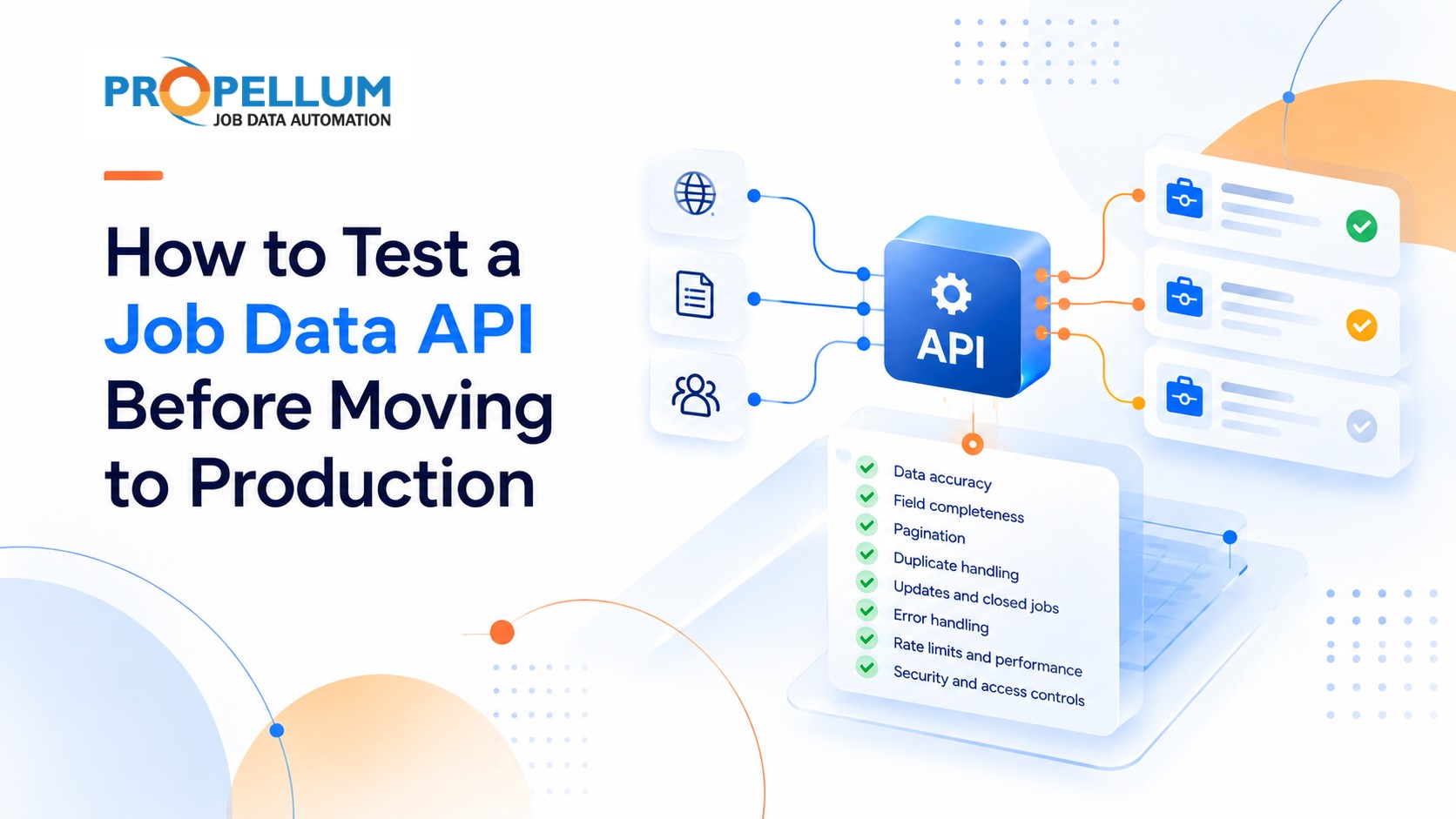
A job data API can return a successful response, deliver thousands of records, and still cause problems for the platform consuming that data. Job listings may contain missing fields. Pagination may cause records to be skipped. Repeated requests may create duplicates. Changes published by employers may not reach the destination system as expected. Each issue can affect the product experience, increase operational costs, and undermine confidence in the data.
That is why testing a job data API requires more than confirming that an endpoint works. Teams need to verify that the data is accurate, complete, consistent, and reliable under real operating conditions. A structured pre-production testing process helps identify these problems before they affect job seekers, customers, or downstream analytics.
Here is how to approach it.
Why Job Data API Testing Matters
A job data API often sits between a data provider and a product that depends on current, structured job information. That product could be a job board, recruitment platform, talent intelligence application, or labour market research system. The API is only one part of the overall workflow. The data must also move through ingestion, validation, transformation, storage, and presentation. A problem at any stage can affect the final result.
Consider a job board that receives 50,000 job records through an API. If the integration imports only 47,000 because it fails to process the final pages of a response, the platform begins with an incomplete inventory. If it imports the same records twice, search results become cluttered with duplicate listings. If it fails to reflect closed positions, candidates may apply for jobs that are no longer available.
These problems are not simply technical defects. They can reduce candidate trust, create support requests, waste engineering time, and weaken the commercial value of the platform.
Effective testing should answer three questions:
- Is the data correct? Do the records accurately represent the information provided by the data source?
- Is the data complete and consistent? Are expected records and fields available in a predictable format?
- Does the integration behave reliably? Can it handle updates, failures, retries, and larger workloads without corrupting the destination dataset?
The following checks help answer those questions.
1. Validate the API Contract Before Testing the Data
Before sending requests, establish exactly how the job data API is expected to behave. The API contract defines what the integration can request, what the provider returns, and how the receiving application should interpret the response.
Review the documentation and confirm:
- Authentication requirements and access permissions.
- Available endpoints, filters, and query parameters.
- Required and optional fields.
- Field names, data types, and permitted values.
- Pagination method and page-size limits.
- Rate limits and expected error responses.
- How the provider represents job updates, closures, and removals.
- Identifier behaviour and versioning arrangements.
This step matters because two APIs can return similar job information while behaving differently. For example, one API might return a posting date in a standard timestamp format, while another uses a date without a time. One might return an empty string for an unavailable salary, while another returns null or omits the field entirely. If the integration assumes a format that the provider does not guarantee, it may reject valid records or store information incorrectly. The goal is to make the expected behaviour explicit before writing or validating the integration.
Business impact: A clear API contract reduces rework, prevents avoidable data mapping errors, and makes future maintenance easier.
2. Check Field Accuracy and Data Completeness
A successful API response does not prove that the job records are usable. The next step is to validate the actual content returned by the API. Begin with a representative sample of records across different job types, locations, employers, and employment categories. Compare the returned data with the provider’s documented fields and, where possible, the original employer posting.
Check both field completeness and field meaning.
| Field | What to validate | Why it matters |
| Job ID | Present, valid, and consistent with the provider’s identifier rules | Supports record matching and update processing |
| Job title | Non-empty and correctly mapped | Supports search relevance and categorisation |
| Company | Correct employer name and mapping | Enables company-level search and analysis |
| Location | Correctly formatted and mapped to the intended location field | Supports geographic filters and discovery |
| Job description | Content is present and not unexpectedly truncated | Helps candidates understand the role |
| Posting date | Correct format and meaning | Supports sorting and freshness checks |
| Application URL | Valid where required and points to the intended application destination | Helps prevent broken application journeys |
| Salary and skills | Values are represented consistently when supplied | Supports filtering, recommendations, and analysis |
Not every field will be available for every job. Salary, for example, may not be disclosed by an employer. A test should therefore distinguish between legitimate missing data and an integration defect. A useful test is to define which fields are mandatory, which are optional, and what constitutes a valid value for each field.
Also check whether the integration handles unexpected values safely. A missing location should not cause the entire import to fail unless the business requirements explicitly make that field mandatory.
Business impact: Field-level validation helps protect search quality, prevents broken user journeys, and reduces the manual effort required to investigate poor records.
3. Test Pagination and Record Completeness
Many APIs return large datasets across multiple pages rather than in a single response. Pagination allows the client to retrieve those records in manageable batches. However, an integration can process the first response correctly and still miss data if it fails to follow the remaining pages. Test pagination using a dataset that is large enough to require multiple requests.
Verify that the integration:
- Retrieves the first page successfully.
- Follows the documented next-page token, cursor, or page parameter.
- Continues until it reaches the documented end of the dataset.
- Handles an empty final page or end-of-results response correctly.
- Does not skip records or import the same record multiple times across pages.
Do not assume the number of records returned in one response represents the complete dataset. Where the provider exposes a reliable total count, compare it against the number of records retrieved. If no total count is available, use alternative checks, such as validating pagination completion and comparing identifiers across the resulting dataset. For example, if a response returns 100 records per page and the query should produce several thousand records, the test should establish that the integration follows every page rather than stopping after the first batch. Repeat the test with relevant filters if the API supports them. A query filtered by geography or posting date may behave differently from an unfiltered request.
Business impact: Complete pagination prevents inventory gaps. For job boards and data products, missing records can translate into fewer searchable listings, incomplete market coverage, and weaker downstream analysis.
4. Verify Updates, Changes, and Closed Jobs
Job data changes continuously. Employers modify descriptions, adjust locations, update application links, and close positions once they are filled. A production integration must handle these lifecycle changes according to the provider’s documented behaviour.
Test several scenarios:
- New job: A newly available record is imported correctly.
- Modified job: Changes to the title, description, location, or other fields reach the destination.
- Closed job: The receiving system applies the agreed rule for closing, deactivating, or removing the listing.
- Unchanged job: A record without meaningful changes does not trigger unnecessary processing.
- Missing record: The integration does not automatically assume that a record should be deleted merely because it is absent from a partial or filtered response.
The last scenario is particularly important. A record can be absent from a particular API response because of filters, pagination, temporary availability, or the provider’s delivery rules. Absence alone does not always mean that the job has closed. Before launch, establish how the provider communicates record changes and closures. Depending on the API, this might involve status fields, timestamps, change indicators, or a documented reconciliation process.
Also confirm the expected update window. If the provider refreshes data on a schedule, the receiving application should not be designed around an unsupported assumption of instant updates.
Business impact: Reliable lifecycle handling helps keep the platform current, reduces stale listings, and prevents unnecessary manual cleanup.
5. Test Duplicate Handling and Repeat Requests
Duplicate records are one of the most common problems to investigate when integrating external data into an existing database. The integration should use a dependable matching strategy to determine whether a job already exists.
Where the provider supplies a stable unique identifier, the receiving system should preserve that identifier and use it as the primary reference for matching records. If the identifier is not globally unique across sources or environments, agree on a suitable composite key or another matching strategy.
Test at least three cases.
Case 1: The same record is imported twice.
Run the same import twice. The second run should not create another copy of each job.
Case 2: An existing record changes.
Import a record, modify its source data, and import it again. The receiving system should update the intended record rather than create a second listing.
Case 3: A request is retried after a failure.
Simulate a timeout or interrupted process and retry the import. The retry should not leave duplicate or partially corrupted records.
This is closely related to idempotent processing. In practical terms, repeating an operation should not produce unintended additional effects. For an integration that creates or updates records, this usually means implementing a reliable upsert process: update the matching record when it exists and create it only when no match exists. The matching key and update rules must be explicitly defined. A provider’s identifier is useful only if the integration retains it and the destination system can use it consistently.
Business impact: Duplicate prevention reduces storage and processing waste, protects search quality, and keeps record counts and reporting more trustworthy.
6. Test Authentication, Errors, and Recovery
Production integrations encounter more than successful requests. Credentials expire, network connections fail, rate limits are reached, and providers may occasionally return server errors. The integration needs a defined response for each situation.
Test common failure scenarios, including:
| Scenario | Expected integration behaviour |
| Invalid or expired credentials | Detect the authentication failure and follow the approved credential renewal process |
| Insufficient permissions | Log the issue and raise an actionable alert |
| Invalid request parameters | Report the error instead of repeatedly sending the same invalid request |
| Rate limit response | Respect the provider’s guidance, including any retry delay |
| Temporary server error | Retry only when appropriate, using controlled backoff |
| Network timeout | Handle the uncertain outcome safely before repeating work |
| Malformed or unexpected response | Reject or quarantine affected data and record enough detail to investigate |
Retries require particular care. An integration should not retry every error indefinitely. Authentication failures, invalid parameters, and temporary infrastructure errors need different responses. For transient failures, use a bounded retry policy with increasing delays where appropriate. The system should stop after the configured limit and report the failure rather than silently dropping records or remaining stuck in an endless retry loop.
Any retried operation that changes destination data must also be designed to avoid unintended duplicate effects. The Google Cloud API troubleshooting guidance provides useful background on API errors and retries. The HTTP Semantics specification, RFC 9110, explains why repeatability and idempotency matter when recovering from failed requests.
Business impact: Strong error handling limits data loss, reduces manual intervention, and helps teams recover from temporary problems without compromising record integrity.
7. Test Rate Limits, Volume, and Response Time
An integration that works with a few hundred records may behave differently when processing a much larger dataset. Before production, test against realistic workloads based on the expected record volume, refresh frequency, query patterns, and provider limits.
Measure:
- API response times under normal conditions.
- Total time needed to complete a full retrieval or scheduled sync.
- Number of requests required to process the expected dataset.
- Behaviour when the provider returns rate-limit responses.
- Memory and processing requirements on the consuming side.
- Ability to resume processing after an interrupted run.
The objective is not simply to achieve the fastest possible response time. It is to establish whether the integration can finish its work within the required operating window and remain stable as volumes grow. For example, a platform that refreshes its job inventory weekly needs confidence that the full refresh can complete within its planned window. A product that performs frequent on-demand queries needs to understand the response-time expectations for its user-facing workflows. Set measurable acceptance criteria based on the application’s requirements and the provider’s documented service commitments. Avoid assuming that one universal response-time threshold applies to every job data API.
Business impact: Capacity testing reduces the risk of missed refresh windows, unexpected infrastructure costs, and performance degradation as usage increases.
8. Verify Security and Access Controls
A production-ready integration must protect both the data being transferred and the credentials used to access it.
Confirm that:
- API traffic uses the required secure transport.
- Credentials and access tokens are stored in an approved secrets-management mechanism.
- Logs do not expose API keys, access tokens, or unnecessary sensitive information.
- Permissions are limited to what the integration actually needs.
- Credential rotation and renewal processes are understood.
- Access failures are detected and handled without exposing confidential details.
Security should be tested as part of integration readiness, not postponed until the application is already live. The exact requirements will depend on the provider, the receiving system, the data involved, and the client’s security policies.
Business impact: Proper access controls reduce the risk of unauthorised access, avoidable outages caused by credential handling, and costly security incidents.
9. Build Monitoring and Reconciliation Into the Integration
Testing before launch establishes a baseline. Monitoring helps determine whether the integration continues to behave correctly after launch.
A production system should make it possible to answer basic operational questions:
- When did the last successful sync complete?
- How many records did the integration retrieve?
- How many records were created or updated?
- How many failed validation?
- Were any requests retried or abandoned?
- Did processing take longer than expected?
- Are any records failing repeatedly?
Record counts are especially useful when combined with reconciliation. For example, the integration might retrieve 20,000 records but successfully process only 19,700. Without a clear record of the difference, the missing 300 records may remain unnoticed.
The system should therefore track records through the process, from retrieval to successful storage or an explicitly recorded rejection. Where appropriate, reconcile source counts, page completion, and destination processing results. Account for filters and documented exclusions rather than expecting every total to match automatically. Monitoring should also produce actionable alerts. A single temporary request failure may not require immediate intervention, but repeated failures, an unexpected drop in volume, or a missed refresh window may indicate a problem worth investigating.
Business impact: Observability reduces the time needed to detect and resolve issues. It also helps teams distinguish a provider-side problem from a defect in their own integration.
10. Use a Pre-Production Acceptance Checklist
Before approving the integration for production, bring the tests together into a documented acceptance process.
| Test area | Acceptance criteria |
| API contract | Endpoints, fields, authentication, and limits are documented |
| Data validation | Required fields and value formats meet agreed rules |
| Pagination | All expected pages are processed without unintended gaps or duplicates |
| Record matching | Existing records are matched using an agreed identifier or strategy |
| Updates and closures | Changes follow the provider’s documented lifecycle rules |
| Retry handling | Recoverable failures do not create duplicate or inconsistent records |
| Rate limits | The integration respects limits and recovers appropriately |
| Volume and performance | The expected workload completes within the agreed operating window |
| Security | Credentials, permissions, and logging meet the required controls |
| Monitoring | Failed requests, processing errors, and incomplete syncs are visible |
| Recovery | The team can resume an interrupted process and reconcile its outcome |
Not every test needs to be performed manually. Many should become automated integration tests that run whenever the code, configuration, provider contract, or mapping logic changes. Keep the results, known limitations, test dataset, and acceptance decision in a shared record. This creates a useful baseline for future troubleshooting and regression testing.
How Propellum Fits Into the Job Data API Workflow
A job data provider and the application consuming the data have related but distinct responsibilities. The provider is responsible for delivering data according to the agreed scope, format, and delivery contract. The receiving application is responsible for processing that data correctly within its own architecture. The two sides need a shared understanding of identifiers, field definitions, update behaviour, refresh frequency, and error handling.
When evaluating a job data API from a provider such as Propellum, teams should establish the expected response structure, review representative job records, and clarify how updates and closed jobs are communicated. They should also validate that the receiving application can process the data without losing records or creating unintended duplicates.
For a broader explanation of how data moves from employer career pages through processing and delivery, read Inside the Job Data Pipeline: From Employer Career Pages to Job Boards.
It is also worth understanding the relationship between API access and feed-based delivery. The appropriate delivery model depends on whether a platform needs on-demand retrieval or a recurring stream of records. Propellum explains this distinction in Job Board API vs Job Feed: Which Does Your Platform Need?.
The important point is that data access alone does not guarantee production readiness. The integration must preserve the quality and consistency of the data throughout the journey into the final application.
Conclusion: Test the Outcome, Not Just the Connection
A job data API should not be considered production-ready merely because it returns a successful response. The real test is whether the complete integration can retrieve the expected records, preserve their meaning, handle changes, recover from failures, and operate reliably at the required scale. These checks protect more than the engineering workflow. They help maintain current job inventory, improve the reliability of downstream products, reduce manual corrections, and prevent avoidable operational costs.
The most effective approach is to define clear acceptance criteria before development is complete, automate repeatable tests, and monitor the integration after launch. A reliable job data API integration is one that continues to deliver usable data when real-world conditions are less than perfect.
Test authentication, response structure, field accuracy, pagination, duplicate handling, record updates, error recovery, rate limits, performance, and security. Also verify that the complete integration stores the expected records correctly.
It helps prevent missing listings, duplicate records, stale jobs, incorrect field mappings, and failures during data refreshes. These issues can affect user experience, product reliability, and operating costs.
Use a stable identifier supplied by the provider where available, retain it in the destination system, and implement consistent create-or-update logic. Test repeated imports and retries to ensure they do not create additional copies.
Verify how the provider communicates changes and closures, how the integration updates the existing record, and how the destination handles jobs that become inactive. Do not assume that a missing record in a single response necessarily means the job has closed.
No. A successful response confirms only that a request was processed successfully at that point. Production readiness also depends on data correctness, completeness, error handling, repeatability, security, performance, and monitoring.