Building a job board is one problem. Keeping its job inventory fresh, structured, accurate, and scalable is another. At first, building job data in-house can seem straightforward. Connect a few sources, build a crawler, extract listings, and put them into search.
The calculation changes as the platform grows. More sources mean more extraction logic. More listings mean more processing. More frequent updates mean more crawling and infrastructure. Multiple sources introduce duplicates, inconsistent fields, and different definitions of the same job.
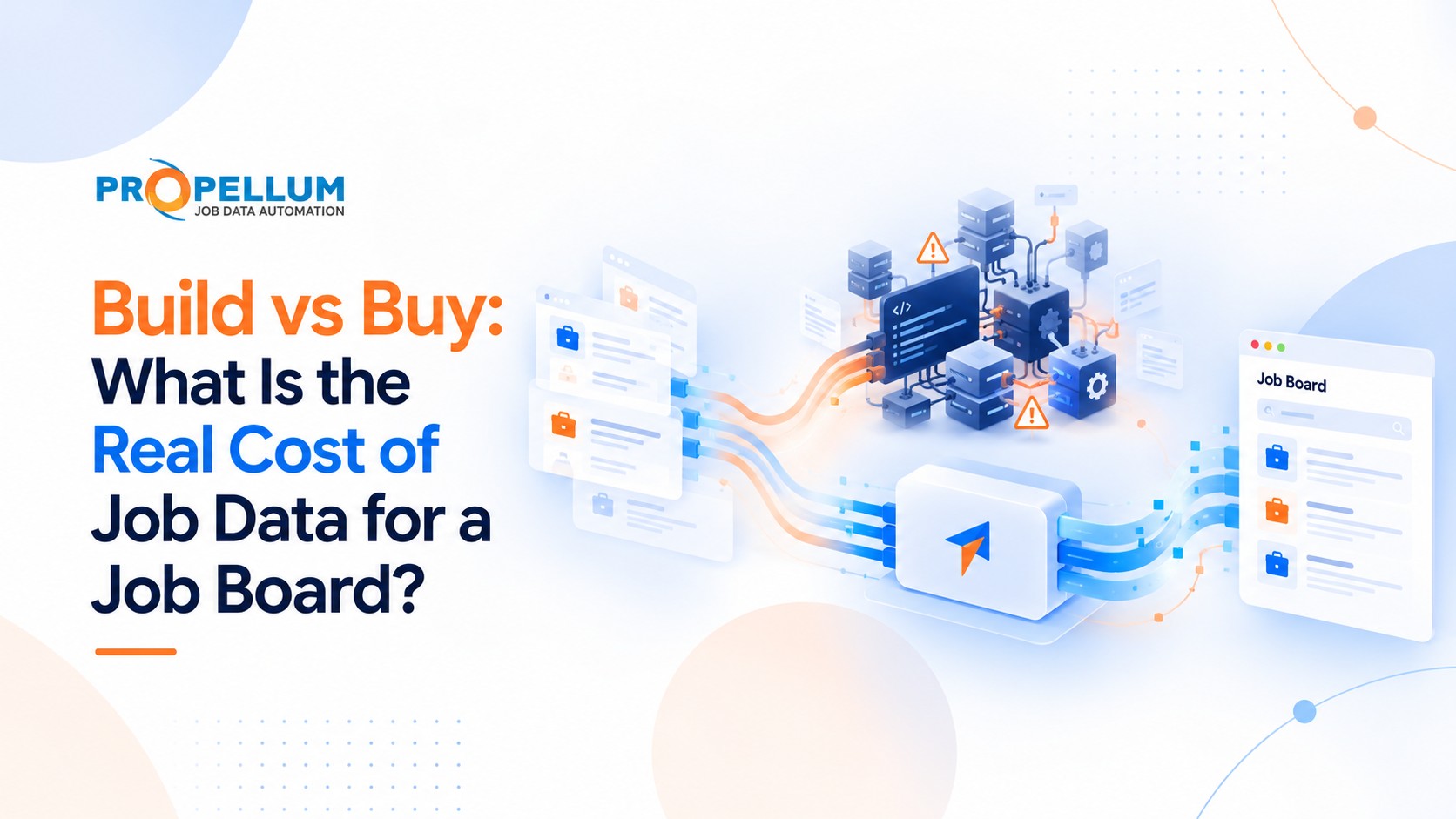
Eventually, the job board is no longer maintaining a scraper. It is operating a job-data infrastructure layer. That is the real Build vs Buy question.
Building job data is not a one-time engineering project
The first crawler is rarely the hardest part. Career sites change their structure. ATS platforms change their templates. URLs change. Pages become JavaScript-rendered. Fields move or disappear. Sources become temporarily unavailable. A production system therefore needs to continuously detect, diagnose, and fix these changes.
The operating cycle becomes:
crawl → extract → validate → detect changes → fix → test → redeploy → monitor
And that cycle continues for every source in the network. This creates a fundamental difference between building a crawler and operating a crawling network. The initial development cost is only one part of the equation. Source maintenance, monitoring, and engineering capacity become recurring costs as coverage grows.
Raw listings are not production-ready job data
Collecting a job is only the first step. A source might describe a position as:
Senior Software Engineer, NYC
Hybrid
150K–180K
5+ years
Another source may represent the same information differently. For a job board, these records need to become consistent, searchable data. That requires normalization of titles, locations, salary, skills, seniority, and employment type.
Then comes deduplication. The same position can appear on an employer’s career site, its ATS, an aggregator, and several job boards. Without deduplication, five records can represent one underlying opportunity.
The result is an important distinction: Raw job volume is not the same as usable job inventory.
A million unprocessed listings may be less valuable than 500,000 clean, current, and deduplicated jobs.
Freshness is another infrastructure problem
A job board also needs to know whether its inventory is still valid. When was a job first seen? When was it last confirmed? Has the description changed? Was it reposted? Has the application URL changed? Is it still active?
This turns job data into a lifecycle problem rather than a collection problem. The system needs mechanisms for refreshing records, detecting changes, and removing jobs that are no longer active.
Crawl frequency matters too. A daily refresh and a near-real-time refresh create very different infrastructure requirements. More frequent updates mean more crawling, processing, validation, and monitoring.
Scaling changes the economics
A pipeline supporting ten sources is fundamentally different from one supporting hundreds or thousands. Adding sources means adding extraction patterns, field mappings, testing and monitoring. Expanding into new countries can introduce different languages, currencies, location structures, and employment terminology.
The data operation therefore grows across several dimensions:
sources + listings + geography + refresh frequency + processing complexity
This is where a job-data pipeline can quietly become a permanent engineering function. And that creates another cost that rarely appears in the original project estimate: engineering opportunity cost. Every hour an engineer spends fixing a crawler is an hour they are not spending improving search, recommendations, employer products, analytics, monetization, or the candidate experience.
What does Build actually cost?
A realistic Build calculation should include more than initial development.
Build TCO = Engineering + Infrastructure + Data Processing + Maintenance + Monitoring + Source Expansion + Scaling + Opportunity Cost
There is no universal number. The cost depends on source count, geographic coverage, listing volume, refresh frequency and the level of enrichment required. That is why comparing the price of a data provider with the salary of one developer gives an incomplete picture. The relevant comparison is the total cost of operating the capability.
What changes when you Buy?
Buying job data moves much of this operational burden outside the product team. Instead of building every layer internally, a job board can connect to a managed provider that handles the underlying data operation.
This is where Propellum fits.
Propellum provides managed job-data infrastructure covering crawling, extraction, normalization, enrichment, deduplication and structured delivery. Job data can be delivered through formats including XML, JSON, and APIs, allowing job boards to integrate the resulting inventory into their own platforms.
The distinction is important. The job board is not outsourcing its product. It is outsourcing the infrastructure required to continuously populate that product with job data.
The engineering question changes from:
How do we build and maintain the system that collects the jobs?
to:
How do we integrate the data and build a better product on top of it?
Build vs Buy is really a question of ownership
Build gives a job board maximum control over the data infrastructure, but also makes it responsible for its operation. Buy introduces a provider cost, but transfers much of the crawling, processing, maintenance and scaling responsibility to a specialist. Neither model is universally better.
Building may make sense when data collection itself is a core competitive advantage, the source universe is limited or the company requires highly specialized infrastructure.
Buying becomes more attractive when a platform needs broad coverage, frequent updates, structured data and continuous maintenance while its engineering team is focused on the product.
The question is therefore not:
“Can we build it?”
It is:
“Is job-data infrastructure something we want to own and operate?”
What should a job board build?
Job boards should invest their engineering capacity in the parts that differentiate their product: search, discovery, recommendations, employer tools, candidate experience, analytics and monetization.
For some businesses, job-data infrastructure will also be a strategic capability worth owning.
For others, it is an operational layer that can be managed by a specialist.
The Build vs Buy decision is ultimately about where complexity should live.
Build the technology that makes your job board different. Buy the infrastructure that doesn’t.
There is no single cost because it depends on source count, listing volume, geography, crawl frequency, enrichment requirements and the engineering architecture. The important point is that the total cost includes ongoing maintenance and infrastructure, not just initial crawler development.
A production pipeline can include source discovery, crawling, extraction, parsing, normalization, deduplication, enrichment, validation, freshness management, monitoring and structured delivery.
It depends on the scale and complexity of the operation. The comparison should use total cost of ownership, including engineering time, infrastructure, maintenance, source expansion and opportunity cost, rather than comparing a provider’s price against the cost of one developer.
What is the difference between raw job data and enriched job data?
Raw job data is information collected from a source. Enriched job data has been processed into consistent, structured fields such as normalized titles, locations, skills, seniority, salary and other attributes required by downstream applications.
When should a job board outsource job data?
Outsourcing becomes more attractive when a board needs multiple sources, broad geographic coverage, frequent updates, continuous maintenance and structured data, particularly when its engineering team is focused on product development rather than data infrastructure.
What does Propellum provide to job boards?
Propellum provides managed job-data infrastructure covering crawling, extraction, enrichment, validation and structured delivery through formats including XML and JSON/API.