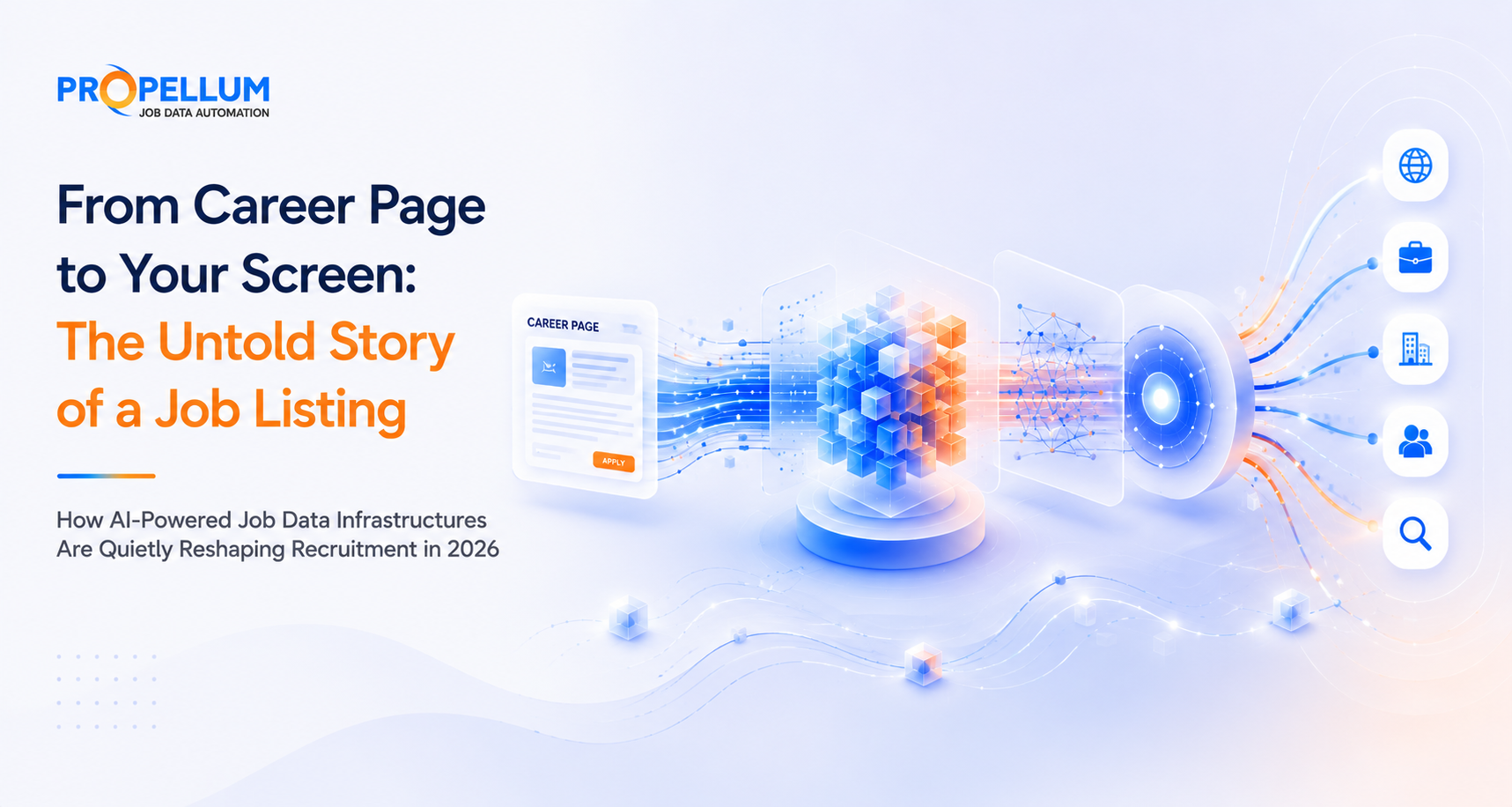
How AI-Powered Job Data Infrastrucures Are Quietly Reshaping Recruitment in 2026
Every day, millions of people open a job board, type in a role, and scroll through listings. It feels instant. Effortless. Like the internet just knows what jobs exist right now.
But here’s what almost nobody talks about: that job listing went on a remarkably complex journey before it ever reached your screen.
In 2026, with AI reshaping the global job market at a speed never seen before. The World Economic Forum projects AI will create 11 million new roles while displacing 9 million by 2030. The infrastructure that moves job data from employers to job seekers has never mattered more. Job boards are under pressure to be faster, smarter, and more accurate than ever.
So let’s pull back the curtain. Here’s exactly what happens between a company posting a job and you seeing it online.
Step 1: A Job Opens Up (The Origin Point)
It starts simply. A company, let’s say a mid-sized fintech firm in Bangalore or a manufacturing plant in Ohio, has a vacancy. Someone leaves, a team expands, a new project kicks off.
An HR manager logs into their Applicant Tracking System (ATS), tools like Workday, Greenhouse, Lever, or SAP SuccessFactors, and creates a job posting. They write the title, description, requirements, and compensation (if their company policy allows it to be disclosed). They hit publish.
The job now lives on that company’s career page, a section of their website, often powered by their ATS, that lists all open roles.
And here’s where the gap begins.
That job is live. But it’s sitting on one company’s website, buried among thousands of other company career pages across the internet. No job seeker is going to visit 50,000 individual company websites to find their next opportunity. That’s what job boards exist to solve.
But how does the job board find that listing?
Step 2: The Crawler Wakes Up (AI-Powered Job Scraping)
This is where automated job scraping, also called web crawling or job spidering, comes in. And in 2026, it’s far more sophisticated than it sounds.
A job data crawler is a software agent that systematically visits company career pages, detects new job postings, and extracts the relevant data. Think of it as a highly intelligent, tireless reader that visits millions of pages so job seekers don’t have to.
But modern career pages aren’t simple HTML files anymore. They’re dynamic, JavaScript-rendered applications built on React, Vue, or Angular frameworks. They load content asynchronously. They have bot-detection systems, CAPTCHA protections, and rate limits. Some are hosted on ATS platforms with unique URL structures and session requirements.
This is where AI-powered crawling changes everything. Modern job crawlers use:
- Natural Language Processing (NLP) to understand page structure and identify job content even when the HTML layout changes
- Machine learning models trained on millions of career page patterns to adapt to new formats automatically
- Intelligent retry logic that handles downtime, anti-bot measures, and JavaScript rendering without human intervention
- Real-time monitoring that detects when a job goes live or expires, sometimes within minutes of the change
The result: comprehensive, real-time coverage of employer career pages at a scale no human team could ever match.
Step 3: Raw Data Enters the Pipeline (The Messy Reality)
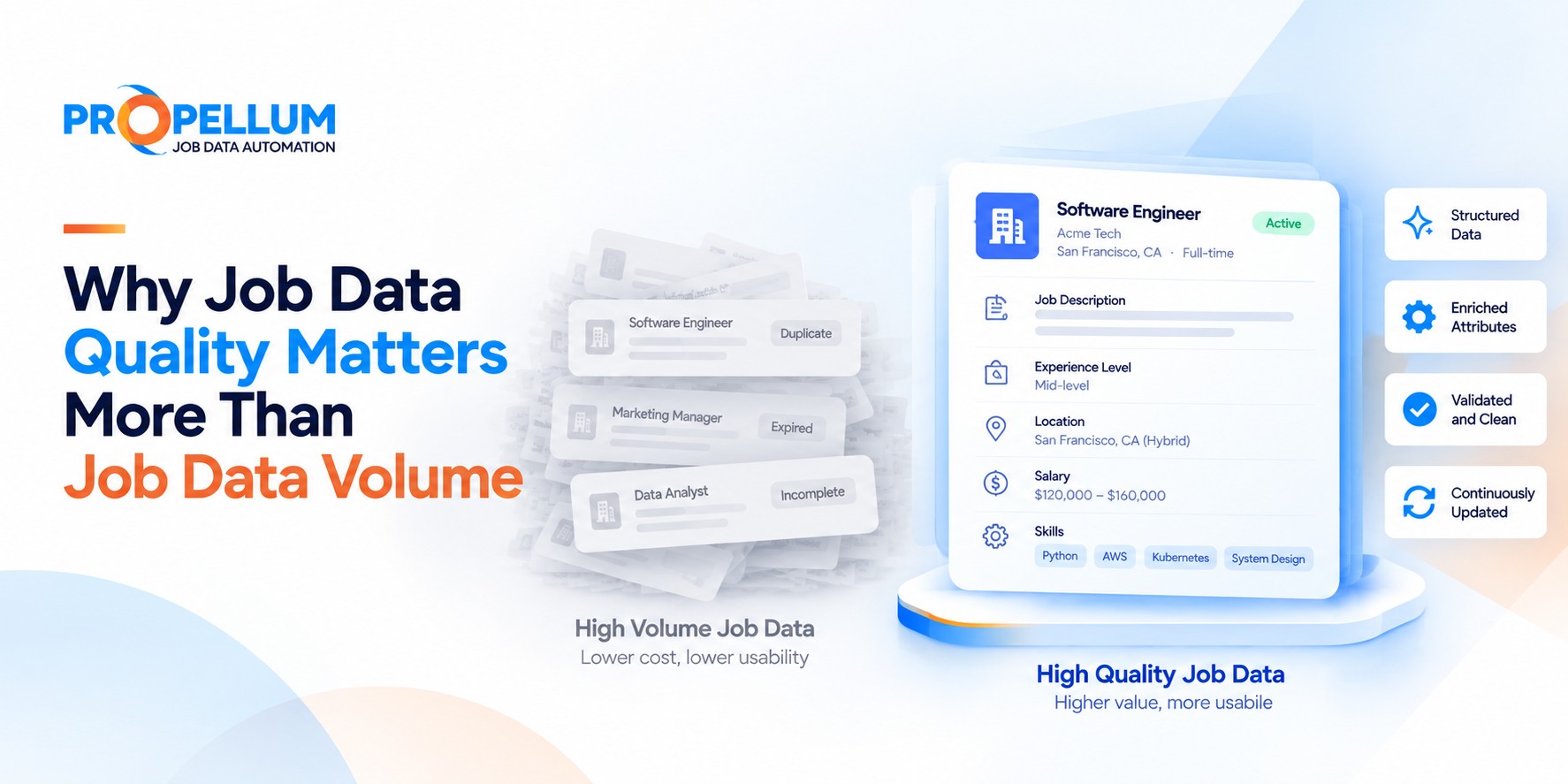
Here’s something the recruitment industry rarely admits: most raw job data is a mess.
When a crawler pulls job listings from across the internet, it encounters inconsistencies that would make any data scientist wince:
- A job titled “Sr. Dev” on one site and “Senior Software Developer” on another, the same role
- Location listed as “NYC” in one posting, “New York, NY” in another, and “Remote (EST preferred)” in a third
- Salary fields that are blank, vague (“competitive compensation”), or formatted differently across every source
- Job descriptions in eight different languages, with some mixing two languages in a single post
- Duplicate listings, the same job posted by the employer directly and syndicated through three different recruitment agencies
- Expired jobs that the company forgot to take down, still appearing as “active”
In 2026, with AI and automation driving a surge in job posting volume across industries, particularly in AI/ML engineering, cybersecurity, data science, and green energy, this data quality problem is getting bigger, not smaller.
A raw, unprocessed job feed delivered directly to a job board would be unusable. Job seekers would see broken listings, wrong locations, duplicate postings, and roles that no longer exist.
This is why the next step in the pipeline is the most critical one.
Step 4: AI Enrichment, Turning Raw Data into Structured Intelligence
Job data enrichment is the process of taking incomplete, inconsistent raw job data and transforming it into clean, structured, contextually rich information that both job boards and job seekers can actually use.
In 2026, this is powered almost entirely by AI. Here’s what modern enrichment looks like:
Title Normalization
NLP models standardize job titles across thousands of naming conventions. “Sr. Dev,” “Senior Developer,” “Senior Software Engineer,” and “SWE II” all get mapped to a consistent taxonomy, making job search filters actually work.
Location Intelligence
Geocoding and location parsing models convert vague or inconsistent location strings into precise, structured geographic data, city, state, country, latitude/longitude, enabling accurate “jobs near me” functionality that job seekers expect.
Skills Extraction
This is increasingly critical in 2026. With 39% of current skill sets expected to become outdated by 2030, job boards need to surface not just job titles but the specific skills required. AI models scan job descriptions and extract structured skills data, “Python,” “LLM fine-tuning,” “Agile,” “ISO 9001”, enabling skills-based job matching.
Salary Enrichment
Only about 30% of job postings globally include upfront salary information. AI enrichment models can benchmark and estimate salary ranges based on role, seniority, location, and industry, a feature that dramatically increases job seeker engagement.
Deduplication
AI deduplication models compare job postings across sources and consolidate identical or near-identical listings into a single, canonical record. This prevents job seekers from applying to the same role twelve times across twelve different job boards.
Expiry Detection
Machine learning models monitor job listings for signals that a role has been filled, the career page URL going dead, changes in page content, ATS status updates, and automatically mark those jobs as expired so they never surface to job seekers.
Step 5: Quality Assurance at Scale
Before any job reaches a job board, it passes through a multi-tiered quality assurance process, a step that separates professional job data infrastructure from amateur scraping tools.
Quality checks include:
- Completeness validation – Does every required field have a value? Title, location, description, employment type?
- Consistency checks – Does the job title match the seniority indicators in the description?
- Freshness verification – Is this job still live at the source?
- Format compliance – Is the data structured according to the job board’s specific schema requirements?
- Language detection – Is the listing in the correct language for the target market?
This QA layer is what eliminates the need for job boards to maintain their own data operations teams, a significant operational cost saving that lets boards focus on growth instead of maintenance.
Step 6: Delivery, The Final Mile
Clean, enriched, validated job data now needs to reach the job board, and it needs to do so in exactly the format, schedule, and volume the board requires.
Modern job data delivery supports multiple formats and methods:
- XML and JSON job feeds, The most common formats, structured for easy ingestion by job board databases
- Direct API integration, Real-time job posting via the job board’s own API, enabling listings to appear within minutes of going live at the source
- Secure FTP transfers, For job boards with legacy infrastructure that requires batch delivery
- Custom data schemas, Every job board has its own database structure; professional job data providers map enriched data to each board’s specific field requirements
Delivery scheduling is also highly customizable, some boards want continuous real-time feeds, others prefer structured batch deliveries at set intervals. Enterprise job boards processing millions of listings daily need infrastructure that can handle that volume without latency or failure.
Why This Pipeline Matters More Than Ever in 2026
The stakes for getting this right have never been higher.
The job market is in flux. AI is simultaneously eliminating roles (administrative, data entry, customer service) and creating entirely new ones (AI engineers, prompt specialists, MLOps engineers). Job seekers are navigating this with urgency. They need job boards that surface accurate, current, relevant listings, not stale data from two weeks ago.
Job board competition is intensifying. With AI giants entering the recruitment space directly, traditional job boards need to differentiate on data quality and user experience. A board with richer, more accurate, more current job data wins.
The volume problem is real. The global job posting volume is accelerating, driven by AI-related hiring surges, green energy expansion, and healthcare growth. Job boards need data infrastructure that scales with that volume automatically, without proportional increases in headcount or cost.
Job seekers have zero tolerance for bad data. A single experience with a dead listing, a wrong location, or a duplicate posting erodes trust. In a market where job seekers have dozens of platforms to choose from, data quality is a retention strategy.
The Invisible Infrastructure Behind Every Successful Job Board
Most job seekers will never think about any of this. They’ll open a job board, find a listing that matches their skills and location, click apply, and move on. That seamless experience is exactly the goal.
But behind it is a sophisticated, AI-powered data pipeline, crawling, enriching, validating, and delivering job data at a scale and speed that would be impossible to replicate manually.
At Propellum, we’ve been building and operating that pipeline for over 25 years, processing over a billion jobs across 15+ countries, for some of the world’s largest job boards.
The job boards get the spotlight. We keep the engine running.
Want to see what a clean, enriched, real-time job feed looks like for your job board? Request a free test feed →