A current job posting tells you what an employer is looking for today. It does not tell you whether that demand is growing, declining, seasonal, or simply part of a short-term hiring cycle.
That distinction matters when businesses use job posting data to understand job market trends, hiring trends, skills demand, and labor market activity. A single snapshot can answer a useful question: What is happening now?
Historical job data allows you to ask a more valuable one: What has changed?
A Job Posting Is a Point in Time
Every job posting captures a moment in an employer’s hiring activity. It can show the role being advertised, required skills, location, seniority, industry, company, and other attributes. When collected consistently, these records become a detailed source of information about employer demand. The value increases when those observations can be compared over time.
Suppose 2% of relevant job postings mention a particular technology today. That tells you the technology appears in a portion of current demand. But what if the same figure was 0.5% two years ago and 1% last year?
The current percentage has not changed the underlying fact. The historical trend has changed its meaning. This is why online job postings are increasingly used in labor market research. OECD research notes that their timeliness and granularity allow analysts to track changes in skill demand and identify emerging trends over time.
Current Job Data Can Hide the Trend
Imagine looking at today’s job market and finding that companies are hiring heavily for data engineers. You might conclude that demand for data engineering is strong. That may be true. But without historical context, you cannot easily determine whether demand is:
- accelerating,
- stable,
- declining from a previous peak,
- concentrated in a few employers, or
- temporarily elevated.
The same problem appears when analyzing companies. A company with 500 open positions today may look like it is expanding aggressively. Historical records might show that it normally carries 400 to 600 openings, making today’s figure less remarkable. Another company with only 100 openings might be more interesting if it normally has 30.
The number matters. The baseline gives the number meaning.
Historical Job Data Makes Change Measurable
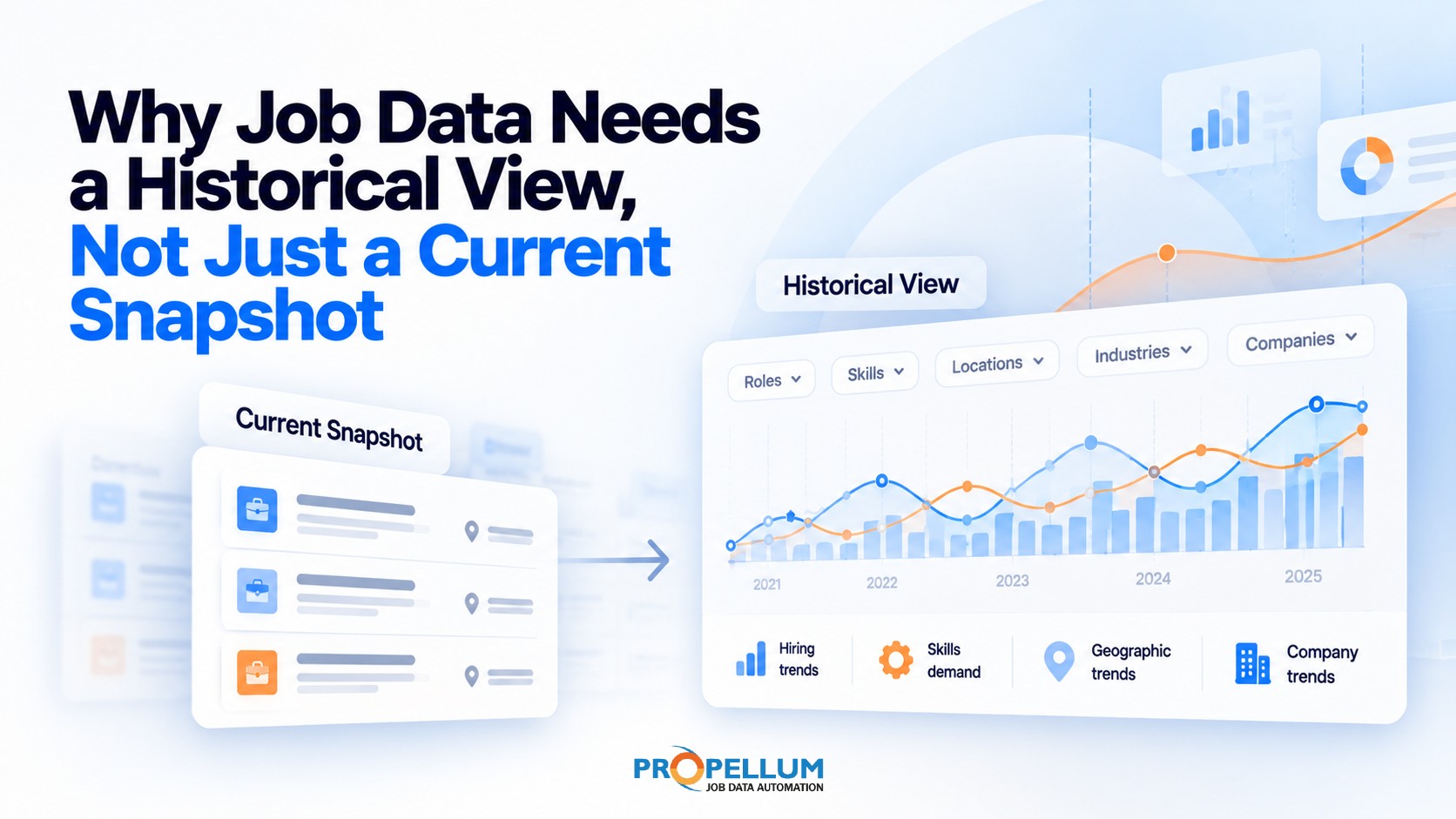
Historical job data allows analysts to move from counting postings to measuring change. For example, a job market analysis can examine:
- Hiring trends: Are employers advertising more or fewer roles than they did previously?
- Skills demand: Which skills are becoming more common in job descriptions?
- Occupation trends: Are certain roles gaining or losing share of employer demand?
- Geographic trends: Is hiring activity moving into new cities, regions, or countries?
- Industry trends: Are particular sectors increasing demand for specific capabilities?
- Company trends: Is an individual employer changing the types of roles or skills it recruits for?
These questions are difficult to answer reliably from a current dataset alone. They require observations that can be compared across consistent time periods.
The Importance of Consistency Across Time
Historical data is only useful when the records remain comparable. Consider a dataset where job titles were classified differently every year. Or where company names changed between records. Or where a skill taxonomy was updated without applying the same logic to older records.
An apparent trend could then be caused by a change in data processing rather than a change in employer behavior. Reliable job data analytics therefore depends on more than storing old records. Historical job data should preserve important attributes such as:
- when the job was observed,
- where it originated,
- its original and normalized title,
- company identity,
- location,
- skills and requirements,
- occupation or job family,
- and its status over time.
Deduplication also matters. The same role can appear across multiple sources or be reposted by an employer. Without appropriate processing, repeated records can make activity appear stronger than it actually is.
Historical Context Helps Separate Signals From Noise
Not every change in job postings represents a structural shift in the labor market. Hiring can move because of seasonality. A company may launch a large recruitment campaign. A new location may open. A temporary project may create unusual demand for a particular skill. Historical comparison provides context for these movements.
Comparing month over month can reveal short-term changes. Year-over-year comparisons can help account for recurring seasonal patterns. Longer historical windows can show whether a change is persistent or simply a temporary spike.
The appropriate comparison depends on the question being asked. For a workforce researcher, a multi-year view may reveal how occupational demand has evolved. For a technology company, a shorter window may help identify a recent acceleration in demand for a particular skill. For an investment researcher, point-in-time historical records can be important when testing whether a signal would actually have been visible at the time, rather than relying on information that became available later.
Job Posting Data Is Not the Whole Labor Market
Historical job data is powerful, but it should not be treated as a complete measure of employment or hiring. Online job postings represent jobs advertised through online channels. They do not capture every vacancy, and coverage can vary across occupations, industries, geographies, and employers. OECD research specifically highlights these limitations when comparing online postings with traditional labor market sources.
A posting also does not necessarily represent a completed hire. That means job posting data is best understood as a detailed source of employer demand signals, which can complement official statistics, company disclosures, workforce data, and other research sources. Its strength is the level of detail it provides.
Traditional labor statistics may tell you that demand changed in an industry or region. Job postings can provide additional detail about the roles, skills, employers, and locations behind that change.
From a Job Snapshot to Job Market Intelligence
The difference between current and historical job data ultimately comes down to context.
A current dataset can answer:
– What jobs are available now?
A historical dataset can help answer:
– How has employer demand changed?
That second question is where job data becomes much more useful for labor market intelligence, workforce intelligence, job market analysis, and business research. It allows organizations to establish baselines, measure changes, identify emerging patterns, and investigate whether a signal persists across time.
For teams working with job posting data, the goal should therefore not be simply to collect the largest possible number of records. It should be to preserve enough history, consistency, coverage, and structure to make change measurable. Because a snapshot tells you what the market looks like. History tells you where it is going.
Platforms such as Propellum can help turn continuously collected job postings into structured datasets that can be analyzed across companies, locations, roles, skills, and time periods.
Frequently Asked Questions
Historical job data is a collection of job postings preserved across time, allowing analysts to compare employer demand, roles, skills, locations, and other attributes across different periods.
It provides a baseline for understanding whether changes in job postings represent sustained trends, short-term fluctuations, seasonal effects, or changes concentrated among particular employers or markets.
Job postings can be structured and aggregated by factors such as occupation, industry, company, location, and skills, then compared across time to identify changes in employer demand.
They can show whether particular skills are becoming more or less prevalent in advertised roles and whether those skills are spreading across occupations, industries, or geographies.
No. A job posting represents an advertised vacancy, not necessarily a completed hire. Posting data is best interpreted as a source of employer demand signals and should be considered alongside other labor market measures.
Consistent collection, deduplication, stable company and job classifications, normalized skills and titles, source coverage, timestamps, and preservation of point-in-time observations all help make historical comparisons more meaningful.