Job postings used to be an HR artifact. Today, they’re something very different.
They’re used to track competitor expansion, monitor hiring velocity, detect new product bets, power sales intelligence, train AI models, and forecast labor market trends. For founders, product teams, sales ops, and strategy leaders, job postings data has quietly become one of the richest public signals about what the market is actually doing.
In theory, this should be one of the most valuable real-time business intelligence feeds in the world. In practice, almost nobody can turn it into anything reliable.
And that gap, between how important hiring data has become and how broken the underlying pipelines still are, is quietly breaking products, AI systems, dashboards, and decisions across the market.
Why Job Data Suddenly Matters
Five years ago, job data was mostly operational. Companies posted roles, candidates applied, and the data lived and died inside ATS systems.
That mental model no longer holds.
Today, teams use job posting data to track which competitors are scaling teams, detect geographic expansion before press releases, identify emerging roles and skills, build sales lead-scoring models, train AI in hiring systems, and monitor hiring demand by function and industry.
Job postings aren’t just HR content anymore. They’re public indicators of growth, priorities, and strategic direction.
Which makes one thing painfully clear:
If your hiring data is wrong, stale, or incomplete, your business decisions are wrong in invisible ways.
The Illusion of Job Scraping
Almost every company that touches hiring data starts the same way. Someone spins up a few scripts. They do some job scraping. They point a crawler at job boards and career pages, dump everything into a database, and wire up a dashboard.
At first, it feels like a win.
Data starts flowing. Charts update. Leadership gets excited. Product teams plan features around “hiring signals.” AI teams start training models on “labor market data.”
It looks cheap. It looks fast. It looks solved.
But this is the trap.
Scraping isn’t infrastructure. It’s raw extraction. And raw extraction is where serious problems begin, not where they end.
Why Scraping Feels Cheap but Is Actually Expensive
Scraping gives you data quickly. What it doesn’t give you is a system.
As soon as your product or model depends on that data being accurate, fresh, and complete, the hidden costs start showing up.
Scrapers fail silently when websites change. Coverage gaps go unnoticed. Duplicate jobs inflate your metrics. Expired roles keep showing as “open.” Job titles and companies remain inconsistent. Downstream teams spend hours cleaning data manually.
This is where most internal job data pipelines quietly turn into technical debt.
What looked like a shortcut becomes a permanent maintenance burden. Engineers start babysitting pipelines. Product teams stop trusting dashboards. AI teams struggle with model drift.
Scraping didn’t save you money. It just deferred the bill.
Why Data Quality Failures Stay Invisible
The most dangerous thing about bad hiring data is that it doesn’t fail loudly.
Nothing crashes. Nothing throws an error.
But underneath the surface, things quietly drift.
A career page changes layout and half its jobs disappear. A role gets reposted across boards and counted as “new.” A title gets misclassified and suddenly your trend chart spikes. An expired job keeps influencing your analytics.
This is why data normalization and deduplication aren’t “nice-to-haves.” They’re the difference between hiring intelligence and fiction.
Most teams don’t notice this decay until something painful happens, sales target the wrong accounts, an AI model hallucinates trends, or an exec loses trust in the dashboard.
By the time the problem becomes visible, the damage is already done.
Why “Real-Time” Is Mostly Fake
At this point, many teams upgrade their story.
They stop saying, “We scrape jobs.”
They start saying, “We have real-time job data.”
But in reality, most so-called real-time hiring data is just batch feeds, CSV exports, and dashboards built on stale snapshots. If your system can’t reliably tell you which jobs changed recently, which roles were removed, or which companies just started hiring again, then you don’t have real-time intelligence.
You have yesterday’s opinion about today’s market.
Without continuous crawling, update detection, and versioned history, your “live” dashboards are always behind reality, and your AI models are training on stale market conditions.
Why Data Normalization Is the Real Moat
This is where most hiring data initiatives collapse. Not because scraping got harder. But because making scraped data usable gets exponentially harder.
Real-world job data looks like this:
- Inconsistent company names
- Dozens of job title formats
- Roles posted across multiple boards
- Locations represented inconsistently
- Skills buried in free text
Scraping collects chaos. Turning chaos into something your systems can reason about requires data normalization, role taxonomies, skill extraction, location standardization, and cross-board deduplication.
This is the real moat.
Not the scraper.
Not the crawler.
Not the dashboard.
The structure layer is in between.
The Missing Layer: From Job Postings to Hiring Intelligence
This is the core mistake the market keeps making.
It’s trying to jump directly from raw job postings to hiring intelligence without building the layer that actually makes that leap possible.
The real evolution looks like this:
job scraping → job data automation → hiring intelligence
Most companies stop at step one.
Serious teams build step two.
Almost nobody has fully operationalized step three.
What Job Data Automation Actually Means
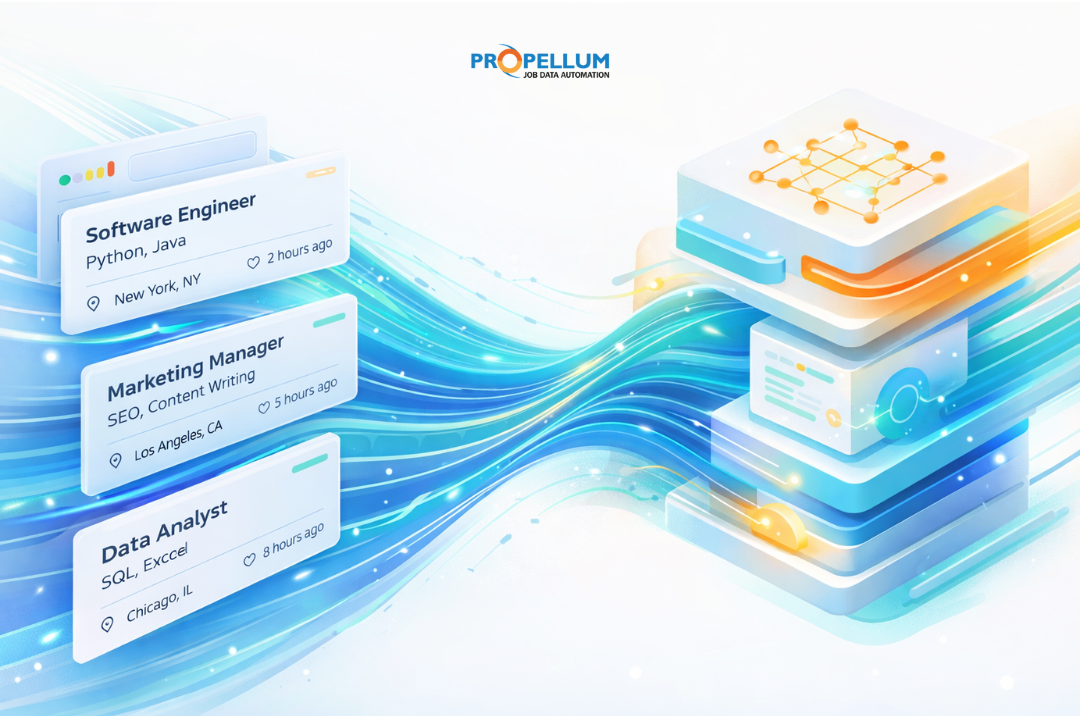
Real job data automation isn’t about scraping more pages. It’s about building a living system that:
- Continuously crawls thousands of sources
- Detects changes in real time
- Normalizes messy job content
- Deduplicates listings across boards
- Standardizes titles, locations, and companies
- Extracts skills and role attributes
- Versions updates and expirations
- Exposes everything through job feeds and a job data API
Scraping gives you raw material.
Job data automation gives you a system.
And systems are what intelligence is built on.
What Becomes Possible When This Layer Exists
Once this infrastructure layer is real, entire categories of products suddenly start working the way they were always supposed to.
Strategy teams can track competitor hiring velocity and spot expansion early.
Sales teams can score accounts based on active hiring and detect budget shifts.
AI teams can train models on clean AI training data and build better AI data pipelines.
Product teams can ship reliable hiring analytics and trend dashboards that don’t lie.
This is what hiring intelligence actually looks like when the plumbing underneath it isn’t broken.
Where Propellum Fits Into This Shift
Propellum exists because this missing layer kept breaking real systems.
It wasn’t built to be another scraper.
It wasn’t built to be another dashboard.
It was built as an infrastructure layer.
Propellum continuously crawls jobs across thousands of sources, normalizes and deduplicates them in real time, and exposes them through APIs, feeds, and automation pipelines.
In other words, it replaces fragile job-scraping stacks with a real job-data automation layer and turns raw job postings into structured hiring intelligence.
That’s the category difference.
Just a system you can actually build on.
Final Thought
If your product, model, or revenue pipeline depends on hiring signals in any serious way, the real question is no longer:
“Can we scrape some jobs?”
It’s:
“Do we actually have job data automation, or just a fragile job scraping stack pretending to be infrastructure?”
Because the difference between those two answers shows up everywhere, in data quality, system reliability, product performance, model accuracy, and customer trust.
And as more companies try to move from job postings to hiring intelligence, that difference is only going to get more expensive to ignore.