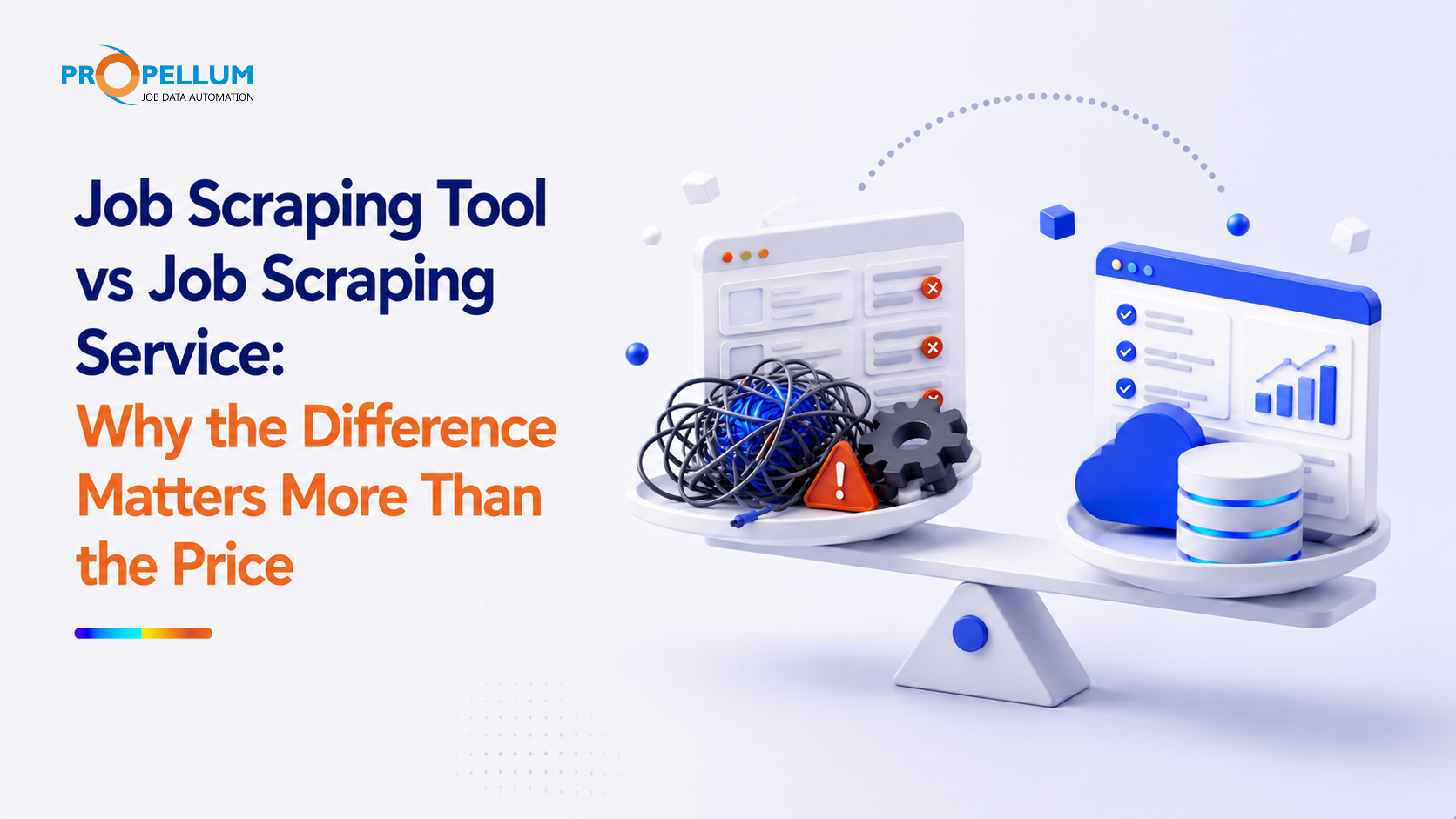
Every comparison of job scraping options online ranks tools by price. Octoparse versus Apify versus ScrapingBee, sorted by monthly cost and CAPTCHA-handling features. That comparison answers the wrong question.
The decision that actually matters comes earlier: are you buying a tool or a service? They solve different problems, fail in different ways, and cost different things — and almost nobody writing about job scraping makes the distinction clear.
What is the difference between a job scraping tool and a job scraping service? A job scraping tool is software you operate yourself — you configure it, run it, fix it when it breaks, and clean the data it returns. A job scraping service is a managed pipeline operated for you — collection, enrichment, and delivery are handled end-to-end, with no engineering maintenance on your side. The tool gives you control. The service gives you a working result.
What a Job Scraping Tool Actually Gives You
A tool is software. You point it at a source, configure extraction rules, and run it on your own infrastructure or theirs.
That means you own everything downstream of the click. When a career page changes its layout, your scraper breaks until someone fixes it. When a site adds CAPTCHA, you solve it or you stop collecting. When the data comes back with no salary, no clean title, and three duplicate copies of the same job — that’s your cleanup job now.
Tools are genuinely useful for a specific kind of need: a one-time data pull, a research project, a small and stable set of sources you’re willing to maintain. For that, a tool is fast and cheap.
For a job board that needs continuous, structured, board-ready data — a tool is the beginning of a project, not the end of one.
What a Job Scraping Service Actually Gives You
A service is infrastructure. You define what you need — which employers, which industries, which regions — and a managed pipeline delivers structured, enriched job records on a schedule.
The maintenance is not yours. When a career page changes its layout, the service adapts and your feed keeps flowing. When a site adds anti-bot defenses, that’s the provider’s problem to solve, not yours. When data arrives, it arrives with salary estimated, titles normalised, and duplicates already removed.
A service costs more than a tool subscription on paper. It costs nothing in engineering hours, on-call fixes, or the slow accumulation of bad data that nobody notices until job seekers start leaving.
Three Moments Where the Difference Actually Shows Up
The career page redesign. An employer rebuilds their site. A tool-based scraper returns empty results until someone notices and reconfigures it — which could be days or weeks. A service-based pipeline detects the new structure and adapts automatically. The listings never stop.
The scale wall. A tool that worked fine at 500 listings starts failing at 50,000 — rate limits, IP blocks, and inconsistent extraction multiply with volume. A service is built to operate at any scale from day one, because that is the entire premise of the infrastructure.
The data quality audit. Six months in, someone finally checks why application rates are low. The tool’s raw output has no salary on 70% of listings, inconsistent titles, and duplicate records nobody deduplicated. A service has been enriching, normalising, and deduplicating every record the entire time — invisibly.
Tool vs Service — Side by Side
| Job scraping tool | Job scraping service | |
| You operate | Yes — configuration, monitoring, fixes | No — fully managed |
| Career page changes | Breaks until manually fixed | Adapts automatically |
| Data enrichment | Raw output — you clean it | Salary, titles, locations enriched |
| Duplicate handling | Manual or none | Automatic |
| Expired listing removal | Manual or none | Automatic |
| Scale ceiling | Limited by your infrastructure | Unlimited |
| Engineering cost | Ongoing | Zero |
| Best for | One-time pulls, small stable sources | Job boards needing continuous, board-ready data |
The Real Question Isn’t Price. It’s What You’re Actually Buying.
A $49-a-month tool and a managed service from a provider like Propellum are not competing for the same budget line. One is software you run. The other is a result you receive.
The job boards that get this wrong usually find out the expensive way — months into a tool-based setup, when application rates are flat and nobody can explain why. The job boards that get it right ask the tool-versus-service question before they sign anything.
Propellum has been delivering job scraping as a managed service for over 25 years — collecting, enriching, and delivering more than a billion job records to job boards including LinkedIn, Monster, and Viadeo. No tools to configure. No pipelines to maintain. Just structured data, delivered.
Get a free test feed — see what a managed job scraping service actually delivers →
Frequently Asked Questions
The subscription cost of a job scraping service is typically higher than a basic tool. But the comparison is incomplete without engineering time. A tool requires ongoing configuration, monitoring, and fixes when sources change — costs that do not appear on a pricing page but accumulate in engineering hours. A service includes that maintenance in the price, which often makes the total cost lower at any meaningful scale.
Some tools can, with additional configuration for headless browser rendering, but this typically requires more technical setup and ongoing maintenance as frameworks update. A job scraping service handles JavaScript-rendered pages automatically as part of the managed pipeline, with no configuration required from the buyer.
A job scraping tool stops being practical once a job board needs continuous, high-volume, enrichment-ready data across many sources. The typical breaking point arrives between a few thousand and tens of thousands of listings, when manual maintenance, rate limits, and data quality issues start affecting job seeker experience and application rates.
A genuine job scraping service includes enrichment as a core part of the pipeline, not an add-on. This means salary estimation for postings missing pay data, job title normalisation, location geocoding, and duplicate removal happen automatically before the data reaches the job board. A basic scraping tool returns raw, unstructured data that still requires this work downstream.
- Why Job Data Quality Matters More Than Job Data Volume
- What Makes Propellum’s Job Data Reliable Enough for AI and Business Intelligence?
- How B2B Sales Teams Use Job Posting Data to Find Companies Ready to Buy
- What Job Data Can Tell Investors & Finance Professionals Beyond Traditional Financial Data
- Inside the Job Data Pipeline: From Employer Career Pages to Job Boards