AI models can reason, classify, recommend, predict, and identify patterns. But for products built around jobs, skills, companies, and labor markets, the model is only part of the equation.
The quality of the output depends heavily on the data underneath it. Job data is scattered across thousands of career sites, ATS platforms, and other sources. It changes constantly, uses inconsistent terminology, and rarely arrives in a format that AI systems can immediately understand.
That is why the opportunity in job data for AI is not simply collecting more job postings. It is turning continuously collected information into structured job data that AI systems can reliably compare, interpret, and act on.
The Problem Isn’t Just Collecting Jobs
Consider three companies hiring for similar roles: Senior Software Engineer, Senior Backend Developer, and SWE III – Platform. The responsibilities and skills may overlap significantly, but the raw records can look completely different.
The same inconsistency appears across locations, skills, company names, employment types, and other job attributes. A job scraping system can collect these postings, but collection is only the beginning.
Before AI can use the information consistently, the data needs to be parsed, normalized, enriched, validated, and continuously updated. The real challenge is not simply getting data from a webpage. It is making that data usable afterward.
From Raw Job Postings to AI-Ready Data
A modern job data pipeline needs to do considerably more than extract HTML. It needs to identify new and expired jobs, normalize titles and companies, standardize locations, extract relevant skills, detect duplicates, validate application links, and keep records current.
The data then needs to move reliably into downstream products through feeds or a job data API. This is the difference between raw extraction and usable job data infrastructure.
A company can collect one million job listings and still have a data problem if those records contain duplicates, inconsistent titles, broken links, and expired jobs. More data does not automatically create better AI. Better data makes better AI possible.
AI Can Move Beyond Keyword Matching
One of the most immediate applications of structured job data is matching and recommendation. AI can compare jobs and candidates across skills, experience, role requirements, and locations to support job recommendations, similar-job discovery, career guidance, and skills-based search.
This matters because candidates and employers rarely use identical language. A candidate may describe their experience differently from the terminology used in a job posting, and structured data gives AI a clearer foundation for understanding those relationships.
Instead of searching for an exact job title, someone could ask: “Find remote backend roles where I can use Python and AWS, preferably at companies that are growing.” AI can interpret that request across structured roles, skills, locations, and company-level signals.
Job Postings Can Become Intelligence Signals
A job posting is more than a vacancy. At scale, it can become a signal about what a company is doing. A sudden increase in AI engineering, regional sales, compliance, or manufacturing roles may indicate changing investment priorities or expansion.
AI can analyze these patterns to support competitive intelligence, sales intelligence, and market analysis. Hiring activity can help identify companies entering new markets, growing teams, investing in technologies, or changing organizational priorities.
Job data is not a replacement for financial or operational data. But it can provide another continuously changing signal that helps products understand business activity from a different perspective.
Structured Job Data Can Reveal What Is Changing
One job posting describes a company’s immediate hiring need. Millions of postings can reveal broader patterns. AI can analyze structured job data to identify emerging skills, changing role requirements, growing occupations, technology adoption, and regional demand.
This creates applications beyond recruitment, including workforce planning, market intelligence, education strategy, and labor market analysis. Job data can help AI systems move from understanding individual vacancies to identifying broader changes in the market.
Why Freshness Changes the Quality of AI
Data quality is not only about whether a record is accurate. It is also about whether it is current. A job may have been filled yesterday, a company may have changed its priorities this week, or a new region may have suddenly started hiring.
If an AI system is reasoning over an outdated dataset, it may produce an accurate answer about a market that no longer exists. Stale data creates stale intelligence.
Continuous job data automation helps detect new, modified, expired, and removed jobs, allowing AI systems to reason over a dataset that more closely reflects what is happening now.
The Model Isn’t the Whole Product
AI projects often begin with the question, “Which model should we use?” For products built around workforce and hiring information, another question may be just as important: “What data will the model actually reason over?”
A powerful model working with duplicated, inconsistent, and outdated job postings can still produce unreliable results. The model may be sophisticated, but the intelligence it produces is still influenced by the quality of the information it receives.
The progression is straightforward: Job scraping → Job data automation → Structured job data → AI-powered intelligence.
Where Propellum Fits Into the Data Layer
This is where a broader job data infrastructure layer becomes important. AI applications need more than extracted job postings. They need data that can move from collection to downstream use without every product team rebuilding the same processing layer.
Propellum supports this workflow through intelligent crawling, job wrapping and feed ingestion, parsing, normalization, enrichment, validation, synchronization, and structured API or feed delivery.
The strategic progression is from job wrapping to AI job data enrichment, and from job scraping to intelligent job data automation. The objective is not simply to collect more jobs, but to make job information useful for the products and intelligence systems built on top of it.
Beyond Recruitment
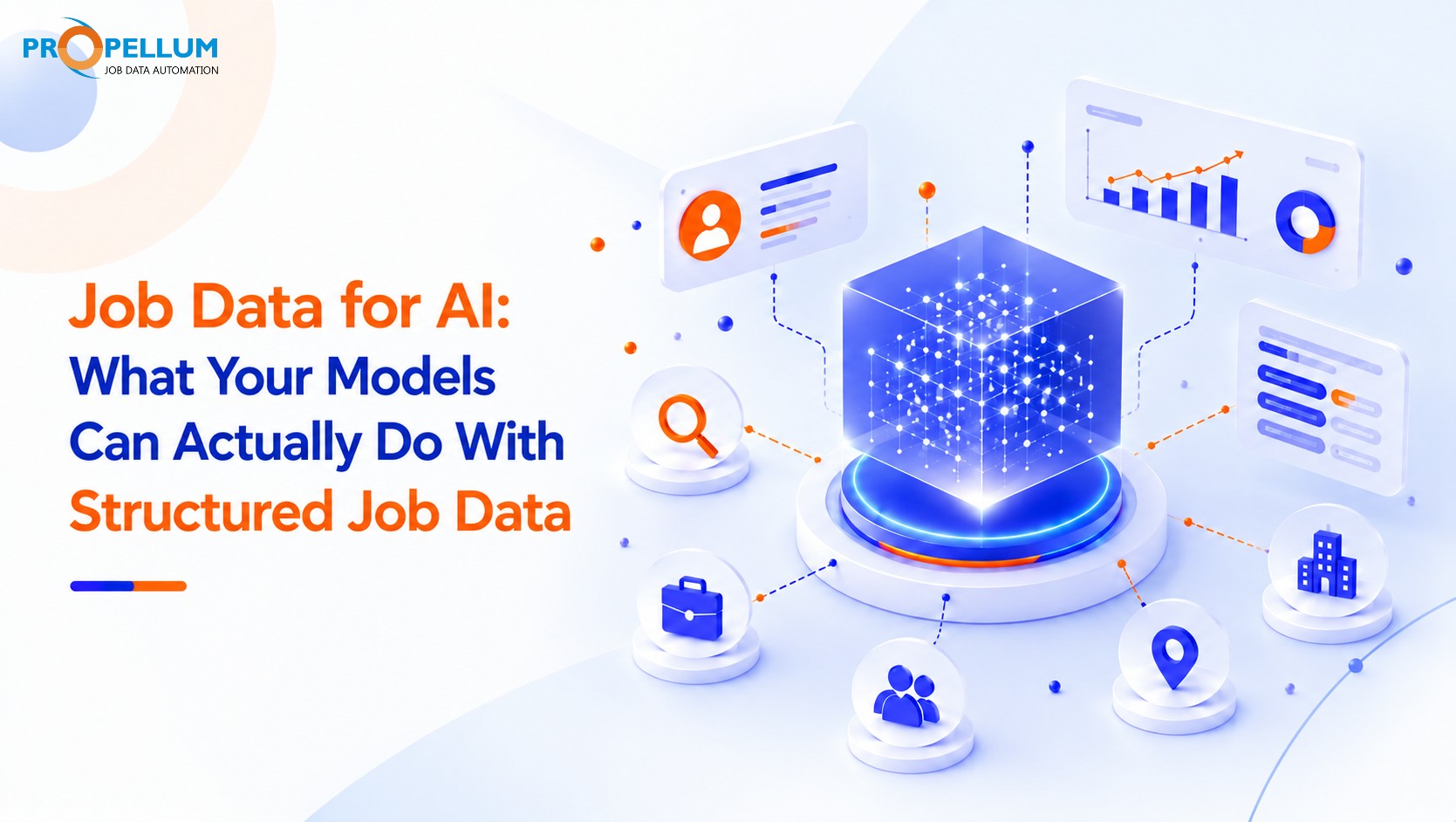
The most interesting thing about job data for AI is that recruitment is only the starting point. The same underlying data can support job search, recommendations, talent intelligence, competitive analysis, sales intelligence, workforce planning, and market research.
As AI products become more capable, the question becomes less about what the model can do on its own and more about the quality of the information it can understand.
Frequently Asked Questions
AI can use structured job data for applications such as job matching, recommendations, skills intelligence, conversational job search, workforce analytics, competitive intelligence, and market analysis. Structured records make it easier for AI systems to compare information and identify patterns across large datasets.
AI-ready job data goes beyond raw job descriptions. Information needs to be consistently extracted, parsed, normalized, enriched, validated, and kept current so AI systems can work reliably with attributes such as titles, skills, companies, and locations.
Job scraping focuses on collecting job information from websites and other sources. A job data API delivers processed job information to downstream applications in a structured format. Between those stages, a job data infrastructure layer can handle normalization, enrichment, validation, duplicate detection, and data refreshes.